“Not many of you were wise according to the flesh, not many were powerful, not many were of noble birth” 1 Corinthians 1:26.
We read that line too quickly. Modern readers are trained to hear it as religious encouragement. God uses humble people. God loves the little guy. God does not care about status. True enough, but that is too tame. Paul is saying something sharper than that.
We live in a world where equality is assumed, at least in theory. We tell children they can become anything. We imagine identity as open ended. Work hard enough, dream big enough, network well enough, and the ceiling can be broken.
That is our world talking. It was not Corinth’s world.
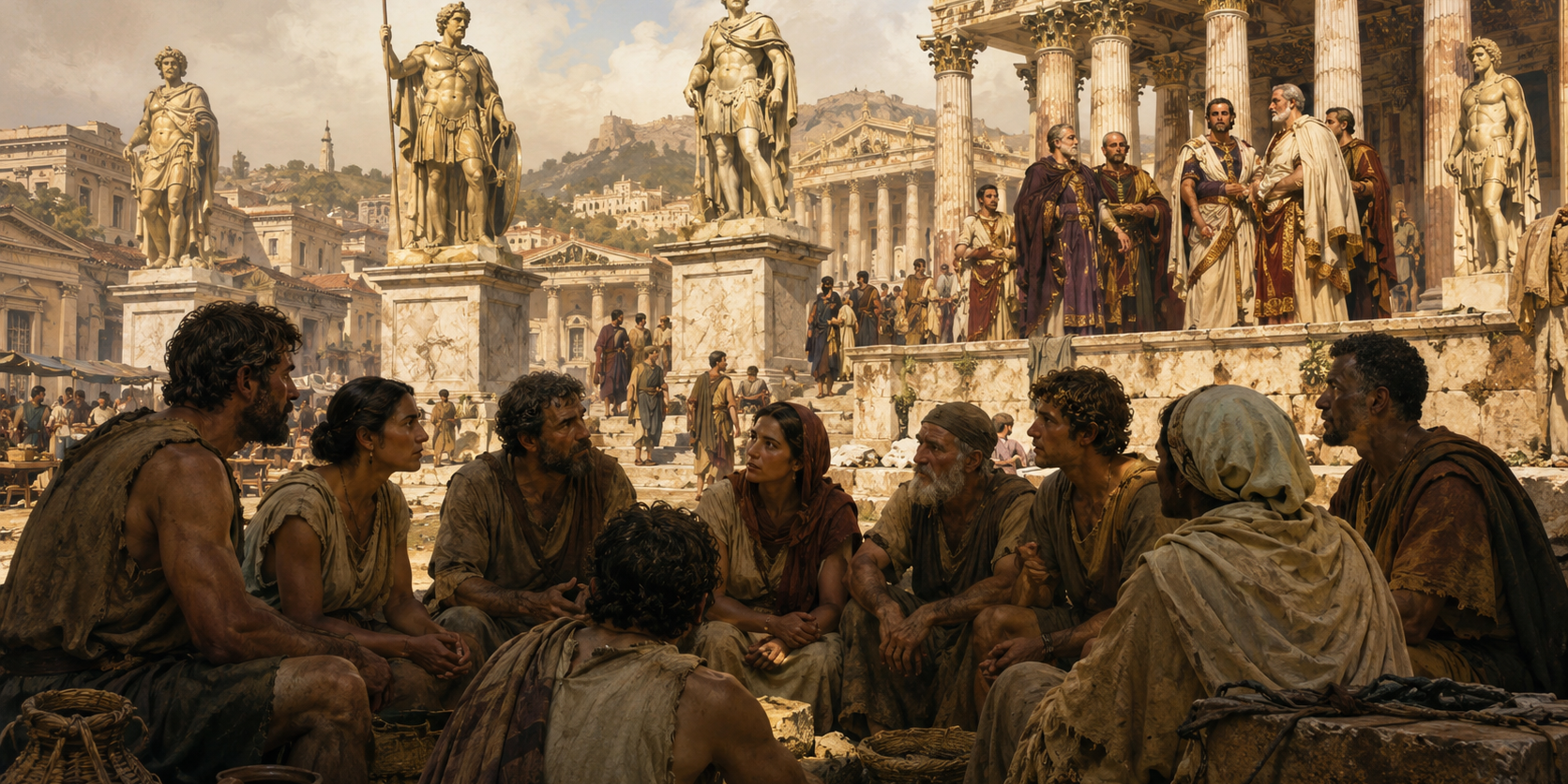
In Corinth, your place was not simply something you chose. Your place was handed to you before you entered the room. Birth spoke first. Family name spoke first. Wealth spoke first. Citizenship spoke first. Patronage spoke first. Honor was not evenly distributed. It was inherited, displayed, purchased, protected, and publicly recognized. Some people were born with a name. Others were born as nobodies.
You could not wake up one morning and decide to be noble born. You could not work your way into ancestry. You could not simply become a senator, a magistrate, a patron, or a public benefactor because you had ambition. Those worlds belonged to people with lineage, money, citizenship, connections, and public standing.
Corinth already knew who mattered. That is what makes Paul’s words so explosive.
When he says, “not many were wise, not many were powerful, not many were of noble birth” 1 Corinthians 1:26, he is not offering a sweet little lesson on humility. He is naming the social fact of the Corinthian assembly. Most of them were not the people the city honored. They were not the people whose names went on inscriptions. They were not the ones funding buildings, hosting banquets, holding office, dispensing favors, or receiving public praise.
They were not the heroes of the city.
And Corinth knew what heroes were supposed to look like. Just look at the Greek imagination. Achilles was the son of a king and a goddess. Odysseus was king of Ithaca. Agamemnon was king of Mycenae. Menelaus was king of Sparta. Ajax was the son of a king. Heracles was the son of Zeus. Perseus was the son of Zeus and the daughter of a king. Theseus belonged to the royal house of Athens. Jason was royal. Aeneas was the son of Aphrodite and a Trojan prince.
The hero was not usually the ordinary man who climbed his way up from nothing. The hero came already marked by blood, by house, by divine favor, by noble birth. The story already began before he acted.
That is the world Paul is confronting in Corinth. Greatness was not merely achieved. Greatness was recognized because it came clothed in the right body, the right family, the right ancestry, and the right public standing.
Then Paul points to the ekklesia and says, look around. Not many wise. Not many powerful. Not many noble. God did not build this assembly out of the people Corinth already admired. He did not gather the impressive, the well born, the socially secure, and the publicly celebrated so that the city could nod in approval.
“He chose the foolish things of the world to shame the wise. He chose the weak things of the world to shame the strong. He chose the low born things of the world and the despised things, the things that are not, to bring to nothing the things that are” 1 Corinthians 1:27 to 28.
That is not vague inspiration. That is social reversal. It is God’s insult to Corinth’s honor system.
The people who would never qualify to run Corinth would one day assist God in ruling the world. That is why Paul can say later, “Do you not know that the saints will judge the world?” 1 Corinthians 6:2. The very people the city would not trust with power, honor, or office are the ones God has marked out for future rule.
But Paul is not saying this merely to inspire them. He is saying it to correct them.
I wish this were only a devotion meant to inspire. It would be easier if Paul were simply telling the Corinthians, “Look how much God values you.” That is true, but it is not the whole point. Paul brings this up because something has gone wrong inside the assembly. The people whom Corinth once looked down on have begun looking at one another through Corinth’s eyes.
They had started rebuilding the very world God had overturned. Worse, they were rebuilding the world they were supposed to bring to nothing.
Paul’s language is not accidental. That phrase “to bring to nothing the things that are” is the key. The assembly itself was supposed to be God’s contradiction of Corinth’s honor system. Their life together was supposed to announce that the old measurements of worth had lost their authority.
But now they were measuring each other by those same old standards. The people chosen to expose Corinth’s hierarchy were starting to reproduce it. The people called to bring that world to nothing were trying to live inside it again.
That is what makes Paul’s correction so sharp. He is not speaking into a neutral situation. The Corinthians are boasting in teachers, forming status groups, attaching themselves to impressive names, and measuring one another by wisdom, speech, power, and honor. “Each one of you says, ‘I follow Paul,’ or ‘I follow Apollos,’ or ‘I follow Cephas,’ or ‘I follow Christ’” 1 Corinthians 1:12.
So Paul reminds them where they came from.
Not many wise. Not many powerful. Not many noble.
In other words, remember how the city saw you. Remember what kind of people God chose. Remember that the assembly exists because God acted against Corinth’s system of worth, not because he baptized it and gave it Christian language.
The tragedy is that the people once dismissed by the world are now tempted to dismiss one another by the same standards. They were not chosen because they were impressive, yet they are now impressed with all the things Corinth taught them to admire.
Paul’s correction is not gentle because the problem is not small. If the ekklesia starts judging by Corinthian standards, it stops witnessing to God’s kingdom and starts mirroring the city around it. It becomes another honor competition, another social ladder, another room where the strong are noticed and the weak are pushed to the edges.
That is why this passage has teeth.
Paul is not merely saying, “God uses unlikely people.” He is saying, “You were the unlikely people, and now you are acting like the world that once despised you.”
That is why Paul refuses to let them boast in the same things Corinth boasted in. Not wisdom. Not status. Not impressive teachers. Not social rank. Not public honor. The only boast left to them is the cross.
“As it is written, ‘Let the one who boasts, boast in the Lord’” 1 Corinthians 1:31.
For Paul, the cross destroys Corinth’s whole system of glory. Rome used the cross to shame the weak, the defeated, and the disposable. But Paul says that is exactly where God revealed his wisdom and power. So if the Corinthians are going to boast, they cannot boast in the marks of Corinthian greatness. They can only boast in the crucified Messiah.
That is the correction.
They were rebuilding a world of status, but Paul points them back to the cross, where that world had already been judged.