“From Paul, called to be an apostle of Christ Jesus by the will of God, and Sosthenes, our brother, to the church of God that is in Corinth, to those who are sanctified in Christ Jesus, and called to be saints, with all those in every place who call on the name of our Lord Jesus Christ, their Lord and ours.”
1 Corinthians 1:1-2 NET
Unfortunately, we have to pause almost immediately.
Paul has barely begun. He has named himself. He has named Sosthenes. He has identified the people to whom he is writing. We are still standing at the doorway of the letter, not yet inside the divisions, the lawsuits, the meals, the idol temples, the spiritual arrogance, the chaotic speech, or the resurrection argument.
But already one English word threatens to carry the modern reader into the wrong world.
That word is church.
For most readers, “church” is not a neutral word. It comes already filled with images. A building. A sanctuary. A pulpit. A pastor. A worship service. A sermon. A denomination. A Sunday morning gathering. Rows of chairs. A religious program. People arrive, sing, listen, greet one another, and leave. In our world, the word “church” almost automatically sounds like a religious service.
But Paul did not write to the “church” in that modern sense.
Paul wrote to the ekklēsia of God in Corinth.
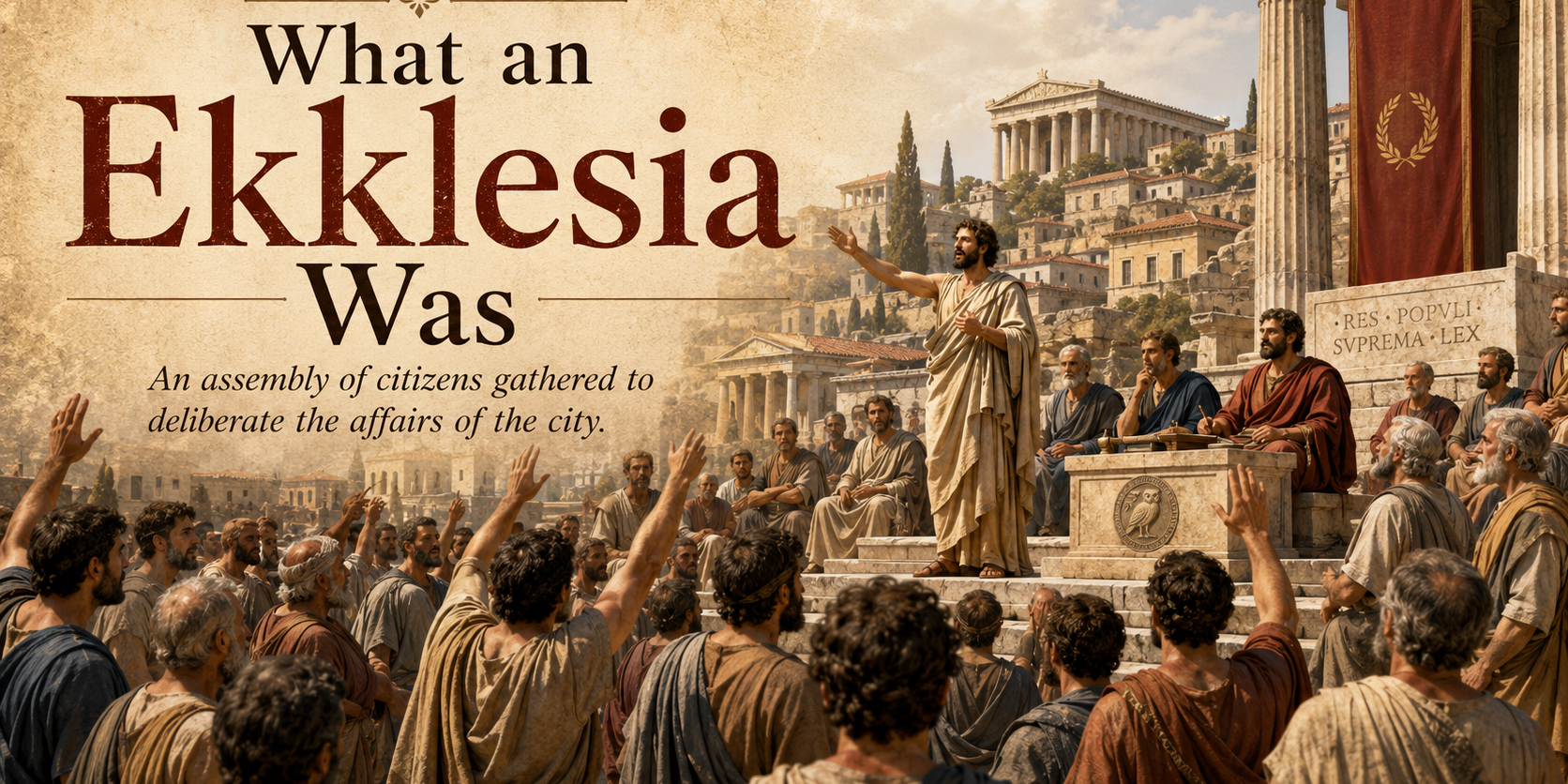
That distinction matters. It is not a clever word game. It is not a fringe claim. It is not an attempt to make Paul sound political by force. Scholars, translators, lexicons, and historians have recognized for a very long time that ekklēsia does not originally mean “church” in the later Christian sense. Its basic meaning is assembly. In ordinary Greek usage, and especially in civic contexts, it referred to a gathered body of people, often citizens summoned to deliberate, judge, decide, vote, or respond to public matters.
The standard Greek lexicon of Liddell Scott Jones defines ekklēsia as “an assembly duly summoned,” especially the assembly of citizens. Strong style lexical summaries also begin with the idea of a called assembly before moving into Christian usage. Britannica, when describing the ancient Greek institution, defines the Ecclesia as the assembly of citizens in a city state.
So the question is not whether ekklēsia can mean assembly. It can. The question is whether the English word “church” still allows modern readers to hear what Paul’s first audience would have heard.
Often, it does not.
The English word “church” does not come from ekklēsia. It comes through Germanic forms related to the Greek kyriakon, meaning something like “the Lord’s house” or that which belongs to the Lord. That is already a different conceptual world. It points the imagination toward sacred space, a house of worship, an institution, a place. But ekklēsia points first toward a gathered people. An assembly. A body called together.
This is why William Tyndale’s translation is so important. In his English New Testament, Tyndale translated ekklēsia as “congregation” rather than “church.” He also translated presbyteros as “elder” rather than “priest,” and metanoia as “repentance” rather than “penance.” These choices were not merely linguistic. They were explosive. Tyndale understood that words carry worlds. If ekklēsia becomes “church,” the reader may immediately think of a religious institution. If it becomes “congregation” or “assembly,” the reader is forced to think of a gathered people.
Tyndale was not alone. Other translators have rendered ekklēsia as “assembly,” “congregation,” or “community,” and the reason is simple: “church” is not the most transparent English equivalent. It is a later Christian word, heavy with later Christian assumptions.
For Tyndale, this was not a harmless vocabulary choice. Rendering ekklēsia as “congregation” challenged the institutional claims of the established church and became part of the wider conflict that made his translation dangerous. The issue was not merely linguistic. It was about authority.
That is why the King James translation matters. When King James authorized a Bible for the English speaking world, the translators were given rules that preserved traditional ecclesiastical language. One rule explicitly stated that “the old ecclesiastical words” were to be kept, and that “church” was not to be translated as “congregation.” So English readers inherited more than a translation. They inherited an institutional vocabulary.
And that is largely why most English Bibles still use “church” today. It is not because “church” is the clearest translation of ekklēsia. It is because “church” became the traditional English rendering. Once a word becomes familiar, especially in religious language, it becomes difficult to replace. Translators know that if they suddenly render ekklēsia as “assembly” everywhere, readers will feel as if something has been changed, even when the translation is actually closer to the word’s ordinary meaning.
So the issue is not that modern translators are hiding something. It is more basic than that. English Bible translation has inherited a tradition. “Church” has become the expected word, the comfortable word, the word readers recognize. But that familiarity comes at a cost. It can cause us to hear Paul through later Christian institutions rather than through the civic and social world in which he actually wrote.
When English readers encounter “church” in Paul’s letters, they are not simply hearing Paul. They are also hearing centuries of institutional translation history. Paul wrote to an ekklēsia, an assembly. But English tradition handed us “church,” and with that word came a whole world of assumptions Paul was not necessarily making.
This does not mean the word “church” is evil. It does not mean every English translator acted dishonestly. The problem is more basic than that. “Church” is an interpretive translation, and for modern readers it often interprets too much too soon. It makes Paul sound as though he were writing to a religious institution that did not yet exist in the form most readers imagine.
So before we can understand what Paul is doing in 1 Corinthians, we have to recover what kind of word ekklēsia was.
Acts 19 gives us the clearest New Testament window.
Paul’s mission has disturbed Ephesus. The silversmiths, whose trade depends on the cult of Artemis, see the danger. If Paul’s message spreads, the idols lose their power, the temple economy is threatened, and the prestige of Artemis is diminished. The city erupts. People rush into the theater. Some shout one thing, some another. Many do not even know why they have gathered.
Luke writes:
“Some therefore cried one thing, and some another, for the assembly was in confusion.”
Acts 19:32
The word translated “assembly” is ekklēsia.
No one thinks this means “church.” This is not a Christian worship service. This is not a congregation gathered for hymns and preaching. This is a public crowd in Ephesus, gathered in civic confusion.
Then the city clerk quiets the crowd. He tells them that if Demetrius and the craftsmen have a legal complaint, the courts are open. There are proconsuls. Let them bring charges properly. Then he says:
“If there is anything further you want to know, it must be settled in the regular assembly.”
Acts 19:39 NET
Again, the word is ekklēsia.
Now the meaning becomes even clearer. The clerk distinguishes between an unlawful, confused gathering and a lawful civic assembly. If the city has business to conduct, if charges must be heard, if public matters must be resolved, there is a proper assembly for that. Not a mob. Not a riot. A lawful ekklēsia.
Then Luke concludes:
“When he had said these things, he dismissed the assembly.”
Acts 19:41
Again, ekklēsia.
Acts 19 makes the point impossible to miss. The same word Paul uses for the Corinthian believers can describe a civic gathering in Ephesus. In that passage, ekklēsia does not mean “church.” It means assembly. A gathered body. A public gathering. In one verse, confused. In another, lawful. In another, dismissed. The context determines what kind of assembly it is, but the word itself does not mean a church service.
But ekklēsia was not merely a generic word for any crowd. In the Greek civic world, it often had a more technical meaning. It referred to the citizen assembly, the gathered body of the city’s people who deliberated, judged, voted, and decided matters of common life.
But even that needs to be stated carefully. In the civic world, the ekklēsia was not just anyone who happened to live in the city. It was the assembly of the citizens. Not everyone had standing there. Slaves did not participate as citizens. Foreigners and resident aliens did not possess the same civic voice. Women were ordinarily excluded from the formal political assembly. The affairs of the city were handled by those recognized as members of the citizen body.
That point will matter later. Paul’s use of ekklēsia does not merely say that the believers are gathered. It says they are being addressed as a people with standing, responsibility, and communal agency. But the basis of belonging has changed. In the ekklēsia of God, standing is not determined by Roman citizenship, Greek status, wealth, free birth, or public honor. It is determined by God’s call in Messiah Jesus.
Thucydides gives us this world in motion.
In his account of the Mytilenean debate, the Athenians face a grave decision. Mytilene has revolted. Athens must decide how to punish the city. The question before them is not worship, preaching, or ritual. It is war, empire, punishment, mercy, and public judgment.
Thucydides writes:
“An assembly was therefore at once called, and after much expression of opinion upon both sides…”
Thucydides, History of the Peloponnesian War 3.36
This is what an ekklēsia did. It gathered citizens. It heard arguments. It weighed competing judgments. It decided what the city would do.
Another example appears when the Athenians consider the Sicilian expedition. Again, this is no religious meeting. Athens is considering a massive military campaign. The future of the city is at stake.
Thucydides writes:
“The Athenians held an assembly and, after hearing from the Egestaeans and their own envoys…”
Thucydides, History of the Peloponnesian War 6.8
The line matters because it shows the assembly functioning as a deliberative body. Reports are heard. Claims are weighed. Action is considered. The assembly is not a passive audience gathered merely to receive information. It is a people gathered to determine a course.
Aristotle gives us the same world from the side of political theory.
In the Politics, Aristotle defines citizenship not merely by residence. To live in a city is not automatically to be a citizen in the fullest sense. A citizen is one who participates in the public functions of the city.
He writes:
“A citizen pure and simple is defined by nothing else so much as by the right to participate in judicial functions and in office.”
Aristotle, Politics 3.1, 1275a
This is crucial. Citizenship is not passive belonging. It is participation in judgment and governance. It is shared responsibility for the ordered life of the community.
In the Athenian Constitution, Aristotle describes the assembly as a regular institution in Athens:
“The Council they convene every day, unless it is a holiday, the Assembly four times in each prytany.”
Aristotle, Athenian Constitution 43.3
The assembly had structure. It had regular meetings. It had business to conduct. Aristotle also says that officials drew up the program for the meetings of the Assembly. In other words, the assembly had an agenda. The city had matters to handle. The people gathered because the public life of the community required judgment, decision, and order.
Polybius, writing in the Hellenistic and Roman period, shows that this language remained meaningful beyond classical Athens. Ekklēsia language was not merely an old democratic relic trapped in the fifth century BC. Greek speaking people under broader imperial conditions still understood the language of assemblies, councils, courts, magistrates, measures, decrees, and public decision making.
Polybius writes:
“Again as concerns all affairs of state administered by the people it is their duty to take these under their charge, to summon assemblies, to introduce measures, and to preside over the execution of the popular decrees.”
Polybius, Histories 6.13
That is exactly the world we need to see. Assemblies belong to affairs of state. Measures are introduced. Decrees are executed. Public matters are brought before the people. The assembly is part of the machinery of common life.
Dionysius of Halicarnassus helps us bridge the Greek and Roman worlds. He was a Greek writer living in Rome in the late first century BC. When he described Roman political life in Greek, he used Greek civic vocabulary to explain Roman institutions.
He writes:
“Because it was not the tribunes who assembled the people, but we, the consuls.”
Dionysius of Halicarnassus, Roman Antiquities 7.16
And again:
“If, now, the assembly had been called by them…”
Dionysius of Halicarnassus, Roman Antiquities 7.16
This matters for Paul. Paul lived in a Roman imperial world, but much of that world spoke Greek. Greek civic language remained available for describing public assemblies under Roman power. Dionysius shows that Greek terms of assembly could describe Roman public life, Roman political procedure, and Roman civic gathering.
Josephus, a Jewish writer under Roman rule, also uses assembly language. This matters because Paul’s word does not only echo the Greek civic world. It also resonates with Jewish scriptural tradition.
Josephus writes:
“On the next day Moses called the people together, with the women and children, to a congregation…”
Josephus, Antiquities of the Jews 4.45
The point here is not that Josephus turns Israel into Athens. He does not. The point is that Greek assembly language could describe a gathered people with public, covenantal, and communal significance. It was not limited to pagan Greek democracy. It could also be used for Israel gathered as a people before God and under law.
The Septuagint, the Greek translation of Israel’s Scriptures, makes this even clearer. The Greek Old Testament often uses ekklēsia for the gathered assembly of Israel.
Deuteronomy speaks of:
“In the assembly of the Lord.”
Deuteronomy 23:1 LXX
This is an important nuance, but it must not be misunderstood. The scriptural use of ekklēsia does not make the word less public, less communal, or less civic. Israel was not a “religious group” in the modern sense. Israel was a covenant people, a nation, a kingdom gathered before the God who ruled them.
So when the Greek Scriptures use ekklēsia for Israel, they are not using the word for a private devotional meeting or a worship service detached from public life. They are using it for the gathered assembly of a people ordered under divine rule. Israel’s ekklēsia is the assembly of a covenant nation, the citizens of a kingdom summoned before their God and king.
That means Paul’s use of ekklēsia does not have to be divided into two separate meanings, one civic and one religious. The scriptural meaning is already public. It is already communal. It is already concerned with a people ordered under God.
In the Greek civic world, the ekklēsia was the assembly that deliberated, judged, and ordered public life.
In Israel’s Scriptures, the ekklēsia was the gathered assembly of a covenant people, the citizens of a kingdom summoned before the God who ruled them.
Paul’s phrase brings these worlds into contact.
He writes to the ekklēsia of God in Corinth.
That is not an accident of vocabulary.
Paul had other words available to him. If Paul wanted to describe a strictly religious gathering, the ancient world had language for that. If he wanted to speak of sacred space, he could speak of the hieron, the temple complex. If he wanted the sanctuary, he could use naos. If he wanted synagogue language, he could use synagōgē. If he wanted to speak of religious associations, cultic groups, philosophical schools, or sacred precincts, the Greek language was not poor.
The Greco Roman world was crowded with gods, temples, cults, associations, dining clubs, philosophical schools, altars, festivals, mysteries, and religious societies. Paul did not lack vocabulary for religion.
The ancient world had terms such as thiasos, eranos, orgeōnes, hairesis, scholē, and synagōgē for various kinds of associations, cultic groups, schools, and gatherings. Paul was not short on vocabulary. But when he addresses the believers in Corinth, he calls them the ekklēsia of God.
A civic word.
That should make us pause.
Paul’s ekklēsia was not “church” in the modern sense of a religious service where people gather for worship, hear a sermon, and then leave. In the Greco Roman world, an ekklēsia was an assembly of citizens gathered to deliberate over the affairs of the city. Paul likely chose, or at least embraced, this term because the early Jesus believers were not merely attending religious meetings. They were learning to live as a distinct people under a different Lord.
This becomes especially clear in 1 Corinthians. Paul is not simply answering private theological questions. He is not merely offering inspirational counsel. He is not providing a manual for a Sunday service. He is addressing a gathered body whose common life is in crisis.
Corinth was a Roman colony with strong status competition, patronage networks, public honor culture, law court activity, imperial ideology, and temple life woven into the social order. Paul’s instructions in 1 Corinthians address precisely those realities: factionalism, boasting, lawsuits, sexual ethics, meals divided by status, spiritual elitism, public behavior, and the question of what kind of people they are becoming together.
Paul’s assembly is being formed in the middle of that world, but not according to that world.
This is why 1 Corinthians 6 matters so much. When Paul tells believers not to take one another before outside courts, he is not merely giving private advice about conflict resolution. He is saying that the assembly should have its own internal moral and communal competence.
“Do you not know that the saints will judge the world?”
1 Corinthians 6:2
That statement is not decorative theology. It is the basis for Paul’s rebuke. If this people is destined to participate in judgment at the level of God’s coming order, then surely they should be able to resolve ordinary disputes among themselves. They are not merely religious consumers. They are an assembly. They must learn to judge.
That does not mean Paul is creating a separatist commune in the sense of total withdrawal. He says the opposite. In 1 Corinthians 5:9-13, Paul explains that he did not mean believers must avoid all immoral people in the world, because then they would have to leave the world entirely. His point is more subtle and more demanding. The assembly lives in the world, but it does not live by the world’s logic. It remains in Corinth, but it must not simply reproduce Corinth.
That is the key.
The assembly is inside the city, but it is not governed by the city’s values.
It is in Corinth, but it belongs to God.
It gathers in the Roman world, but its confession is that Jesus is Lord.
And that confession had unavoidable political implications. Even when Paul is not writing anti Roman propaganda, even when he is not directly attacking Caesar, the claim “Jesus is Lord” relativizes every other lordship. In a world where Caesar was honored with titles, cult, loyalty, benefaction, and public devotion, to confess Jesus as Lord was not a private religious preference. It was an allegiance that reordered reality.
This does not mean every line of 1 Corinthians is a coded attack on Rome. That would be too simple. Paul’s imagination is larger than protest. He is not merely against Caesar. He is for Messiah. He is not merely resisting empire. He is forming a people under the reign of Israel’s God through the crucified and risen Jesus.
This is where the argument has to come down out of the clouds and land in real life. Paul is not forming an idea. He is forming a people, a culture, a society. And that formation shows up in concrete practices.
Shared meals.
Internal judgment.
Sexual holiness.
Economic mutuality.
The reordering of honor.
The refusal to boast in status.
The rejection of idol table participation.
The unity of Jews and Gentiles, slaves and free, men and women, rich and poor in one body.
This is not just doctrine.
It is culture.
Paul is not merely telling individuals what to believe in their private hearts. He is teaching a people how to live together under a different Lord. He is forming habits, boundaries, judgments, loyalties, meals, speech, and communal practices. The assembly is not simply a place where religious ideas are announced. It is the social body in which those ideas become visible.
So when Paul writes “to the ekklēsia of God that is in Corinth,” he is not merely saying, “Dear church members.”
He is writing to a gathered people charged with ordering, maintaining, and displaying what life looks like under the God of Israel and the lordship of Jesus.
That is why “church” can be such a dangerous shortcut. It makes the phrase sound familiar when it should sound startling. It domesticates the word before it has a chance to confront us. It pulls Paul into our world before we have done the hard work of entering his.
That is the tension. That is the drama. That is the whole letter waiting to unfold.
The Corinthians live in Corinth. They cannot pretend otherwise. Their habits were formed there. Their instincts were trained there. Their sense of honor, power, wisdom, speech, sexuality, food, status, and public life was shaped there. But Paul addresses them as something other than a mirror of Corinth. They are an ekklēsia of God within Corinth, and now they must learn what that means.
Before we can understand Paul’s corrections, we have to understand Paul’s address.
He is not writing to a modern church service, a gathering for the sake of songs and a sermon. He is sending a letter to give his input during their meeting, to address the issues of their community. He is not writing to a passive religious crowd. His voice will be one among several voices heard in the assembly, but it is an apostolic voice, and it is being sent into a meeting that will help determine the direction of the community.
As we move through the letter, we will see why Paul chose to write instead of attend in person. Although Paul says this in 2 Corinthians, he is looking back and explaining the reasoning that shaped his earlier decision not to come to Corinth in person. His absence was not avoidance. It was not weakness. It was a deliberate act of restraint.
“Now I appeal to God as my witness, that to spare you I did not come again to Corinth.”
2 Corinthians 1:23 NET
Later, when the matter had still not been fully settled, he warned them that if he came again, they should not confuse his patience for powerlessness (2 Corinthians 13:2-3).
That is where 1 Corinthians begins.
And if we miss that, we will misread almost everything that follows.
The best way to understand Paul’s ekklēsia is as the town hall meeting of an alternative society within the broader Greco Roman world.
I leave you with a thought from Professor Dale B Martin. Professor Dale B. Martin was a major American New Testament scholar and historian of early Christianity. He was the Woolsey Professor of Religious Studies at Yale University, where he taught New Testament and Christian origins. He retired from Yale in 2018 and died in 2023.
https://youtu.be/2m3lmuPBKFE?si=LsJHqGjk-xilHRVO
Recommended Reading
For readers who want to think further about Paul’s assembly in Corinth as a real social body within the Roman world, Richard A. Horsley’s essay is worth reading. Horsley argues that 1 Corinthians should not be read merely as a collection of theological proof texts or private moral instructions, but as evidence of Paul shaping an alternative society inside the structures of Roman imperial life.
That lens is especially helpful for reading 1 Corinthians. Paul addresses lawsuits, meals, status, patronage, idolatry, money, discipline, speech, leadership, and resurrection because these were not isolated “church issues.” They were the practices by which a community learned who governed its common life.
See Richard A. Horsley, “1 Corinthians: A Case Study of Paul’s Assembly as an Alternative Society,” here: