Why the First Day Did Not Replace the Sabbath
In Acts, Sabbath participation is not hidden. It is repeated. Paul goes into the synagogue at Pisidian Antioch on the Sabbath. Luke says, “On the Sabbath day they went into the synagogue and sat down” (Acts 13:14). After Paul speaks, the people beg that these words might be spoken to them “the next Sabbath” (Acts 13:42). Then Luke adds, “The next Sabbath almost the whole city gathered to hear the word of the Lord” (Acts 13:44).
That is not a picture of Sabbath being discarded.
In Philippi, where there seems to be no synagogue building, Paul still follows the Sabbath rhythm. “On the Sabbath day,” Luke says, “we went outside the gate to the riverside, where we supposed there was a place of prayer” (Acts 16:13). In Thessalonica, Luke is even more direct: “Paul went in, as was his custom, and on three Sabbath days he reasoned with them from the Scriptures” (Acts 17:2). In Corinth, the pattern continues: “He reasoned in the synagogue every Sabbath, and tried to persuade Jews and Greeks” (Acts 18:4).
That evidence is difficult to deny. Whatever else we say about Paul, Acts portrays him as continuing to participate in Sabbath synagogue life. Sabbath remains the day of Scripture, prayer, proclamation, and engagement with Jews and God fearing Gentiles.
But that is not all the evidence says.
There are also first day texts. In Troas, Luke says, “On the first day of the week, when we were gathered together to break bread, Paul talked with them” (Acts 20:7). In 1 Corinthians, Paul instructs the community, “On the first day of every week, each of you is to put something aside and store it up” for the collection (1 Corinthians 16:2).
So the evidence gives us both realities. Sabbath synagogue participation continues. First day community activity also appears. The mistake is assuming that one must cancel the other. Later Christian theology often turns the first day texts into a replacement argument: Christians stopped keeping Sabbath and moved worship to Sunday. But Acts itself makes that difficult. The Sabbath evidence is too strong. Paul’s continuing synagogue practice is not incidental. Luke repeats it often enough that the reader is meant to notice it.
At the same time, the first day texts should not be ignored. Something is happening on the first day. Believers are gathering. Bread is being broken. Money is being set aside. Paul is speaking. Communities are organizing support for Jerusalem.
The question, then, is not, “Which day won?”
That is a later question.
The better historical question is, “Are these texts describing the same kind of gathering?”
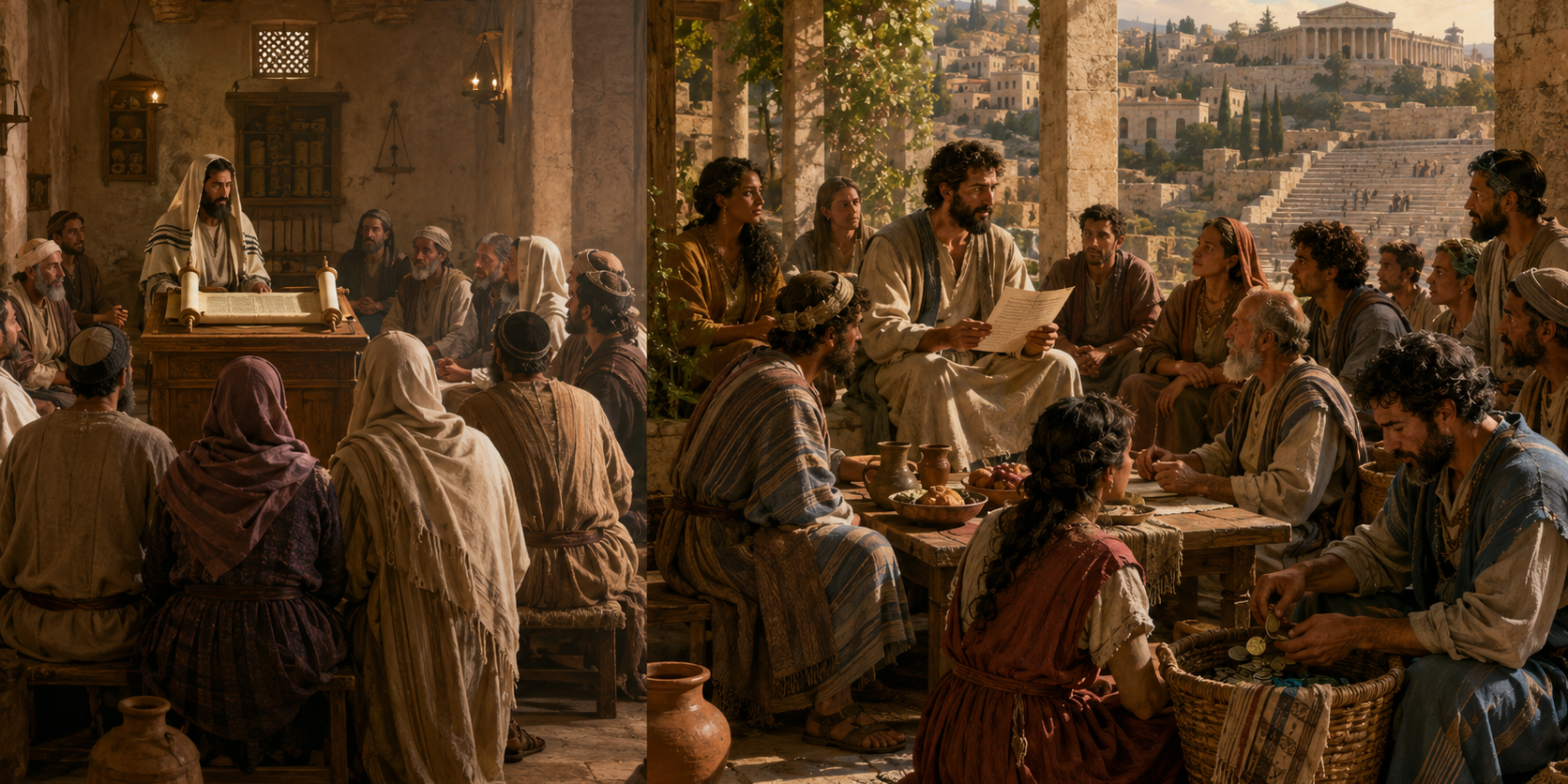
Once that question is asked, the tension begins to resolve. Sabbath belonged to the synagogue rhythm: Scripture, prayer, instruction, and the worship of Israel’s God. The first day appears in connection with another kind of activity: breaking bread, apostolic address, collection, travel, money, and the practical ordering of the community.
That is not necessarily Sabbath replacement.
It may be Sabbath respect.
The assembly had business to conduct, and that business belonged to the days when work could be done.
Acts 19 gives us the missing category.
Acts 19 gives us a clue that is easy to miss because the English word “assembly” has become too ordinary. We hear “assembly” and think simply of people gathered together. Luke’s Greek is more precise, and his scene in Ephesus depends on that precision.
The city is in uproar. Paul’s preaching has touched the nerve of Ephesian public life. Demetrius and the craftsmen are not worried about an abstract theological disagreement. They are worried about money, reputation, civic identity, and the honor of Artemis. Their trade depends on the assumption that gods made with hands are worth buying, venerating, carrying, and displaying. If Paul’s message spreads, the silver shrine business suffers. And if that business suffers, so does one of the great symbols of Ephesian prestige.
So the crowd surges into the theater. Luke’s description is almost comic, but the comedy is dangerous:
“Some therefore cried one thing, and some another, for the assembly was in confusion, and most of them did not know why they had come together.”
Acts 19:32
The word translated “assembly” is ekklēsia.
That is the point. Luke uses the word, but the scene shows us what the word is not.
An ekklēsia was not just a crowd. It was not whoever happened to assemble with enough noise and confidence. In a Greek city, an ekklēsia was a civic body. It had recognized procedures. It had proper channels. It met under lawful conditions. It could deliberate because it had authority to deliberate. A crowd in a theater could mimic the appearance of an assembly, but it did not thereby become one.
The town clerk understands this immediately. He does not say, “You have gathered as the city, so let us decide the matter.” He says the opposite. If Demetrius and the craftsmen have a legal charge, the courts are open. There are proconsuls. Let the case be brought there. Then he adds:
“But if you seek anything further, it shall be settled in the regular assembly.”
Acts 19:39
That phrase matters: the regular assembly. Or, as some translations render it, the lawful assembly.
Luke has already called the crowd an ekklēsia, but the clerk distinguishes between the confused gathering in front of him and the legitimate civic assembly that could actually handle public business. The difference is not semantic decoration. It is political. This gathering is not merely disorderly. It is dangerous. It can be reported as a riot. Rome did not admire unauthorized civic enthusiasm.
That is why the clerk warns them:
“For we really are in danger of being charged with rioting today, since there is no cause that we can give to justify this commotion.”
Acts 19:40
Then Luke concludes:
“And when he had said these things, he dismissed the assembly.”
Acts 19:41
The word remains, but now we have learned how it works. An ekklēsia can be a gathered body, but not every gathered body is a lawful ekklēsia.
This should discipline how we hear Paul.
When Paul writes to the ekklēsia of God in Corinth, he is not simply writing to people attending a worship service. He is addressing a gathered body. He is sending his voice into an assembly that must hear, deliberate, judge, correct, organize, and obey. His letters are not devotional essays. They are interventions in communal government.
This becomes obvious once we stop translating Paul’s world into later church habits. In 1 Corinthians, the assembly must deal with factionalism, lawsuits, sexual misconduct, marriage questions, idol food, table practice, speech in the gathering, prophecy, tongues, resurrection belief, and the collection for Jerusalem. That is not merely “worship.” It is the ordered life of a community.
Paul expects the group to act. He expects them to judge an internal case. He expects them to discipline a member. He expects them to regulate meals. He expects them to organize money. He expects them to recognize emissaries. He expects them to receive letters and respond to apostolic instruction. This is assembly business.
And that observation changes the Sunday question.
Later Christian arguments often move too quickly. They see believers gathered on the first day of the week, and they conclude: Sunday replaced Sabbath. But that conclusion assumes that the gathering in question is the same kind of thing as Sabbath synagogue worship. It assumes that the issue is simply which day became the new sacred day.
But the better first question is not, “Which day replaced Sabbath?”
The better question is, “What kind of gathering are we looking at?”
This matters because both words are Greek. Synagōgē is Greek. Ekklēsia is Greek. The difference is not that one word is Jewish and the other is Christian. The difference is that they are not simple synonyms. They overlap, but they are not interchangeable. By Paul’s day, synagōgē commonly named the Jewish communal institution ordered around Scripture, prayer, instruction, and Sabbath rhythm. Ekklēsia carried the resonance of civic assembly: a gathered body called together to deliberate, order its life, and act. Paul did not need a different word because he had left Jewish life behind. He used a different word because he was describing a different kind of gathering.
Words can work at more than one level. We know this from ordinary speech. The word “judge” can mean any person forming an opinion: “Do not judge me.” But it can also mean an official of the court: “The judge entered the room.” Same word, different weight. Ekklēsia works in a similar way. It can describe people who have assembled. But in its formal sense, it names a recognized assembly, a body constituted to deliberate and act. Acts 19 depends on that distinction. A crowd had assembled in the theater, but that did not make it the lawful assembly.
Paul clearly does not use ekklēsia merely in the casual sense of “some people got together.” He uses it with formal force. His ekklēsia is a recognized body, a people gathered under the authority of Israel’s God and the lordship of Jesus, expected to deliberate, judge, order its life, and act. In Corinth, the ekklēsia must hear Paul’s letter, settle disputes, discipline offenders, regulate meals, organize collections, and discern the speech of the Spirit. That is not a crowd. That is an assembly.
This also explains why ekklēsia can overlap with synagogue language without becoming a synonym for synagogue. People assembled in a synagogue. In that ordinary sense, a synagogue gathering could be called an assembly. But that does not make the synagogue an ekklēsia in the formal civic sense. A Sabbath synagogue gathering was not the assembly of the Greco Roman polis. It did not become the city’s deliberative body simply because people had gathered there. Overlap in casual usage is not the same as identity in formal usage.
This is why the synagogue and the ekklēsia, though related, were not identical. The synagogue belonged to the Sabbath rhythm of Jewish life. It was bound to Scripture, prayer, instruction, ancestral memory, and the public honoring of Israel’s God. It was where Jews, and often God fearing Gentiles, gathered around the practices that marked Jewish communal identity in the diaspora.
The ekklēsia, by contrast, was assembly language. It named a gathered body constituted to conduct the life of a people. For Paul, that people was not the city of Corinth or Ephesus, but the people of Israel’s God gathered under the lordship of the risen Messiah. Their assembly was not less serious than the city’s assembly. In Paul’s imagination, it was more serious, because its Lord was not Caesar, nor Artemis, nor the local civic order, but Jesus.
This does not mean that Paul invented a new Sabbath.
It means that Christ followers had business to conduct.
They had meals to regulate. They had funds to collect. They had messengers to receive and send. They had letters to hear. They had disputes to settle. They had judgments to make. They had the poor to remember. They had Gentiles to instruct in the worship of Israel’s God. They had Jews and non Jews eating at one table, invoking one Lord, and learning how to live as one people without becoming simply another synagogue or another voluntary association.
Much of this work sat uneasily with Sabbath practice. Handling money, arranging travel, sending emissaries, preparing meals, managing disputes, and conducting ordinary communal administration belonged to the working life of a community. Jewish communities themselves knew this. Sabbath was Sabbath. The other days of the week were when ordinary business could be done.
No one would say that Jews abandoned Sabbath because they handled money on the first day, settled a dispute on the second, sent a letter on the third, or received travelers on the fourth. Those things did not replace Sabbath. They belonged to the life that Sabbath interrupted.
So why assume that Jesus believing Jews abandoned Sabbath because their ekklēsia met at another time?
That assumption reveals more about later Christian categories than about Paul’s world.
Paul’s assemblies could meet outside Sabbath not because Sabbath had been discarded, but because the ekklēsia had work to do. The Sabbath synagogue and the Messiah assembly were different forms of gathering. One stood within the ancestral rhythm of Israel’s rest, Scripture, and prayer. The other gathered the Messiah’s people to order their common life.
This distinction helps explain the odd density of Paul’s letters. He is not merely telling individuals what to believe. He is telling a people how to be a people. He writes because the assembly must become capable of judgment. The Corinthians must learn what kind of body they are. They must learn what kind of meal they are eating. They must learn why their lawsuits shame them. They must learn why the wealthy cannot humiliate the poor at the Lord’s table. They must learn why spiritual speech must be ordered for the building up of all. They must learn why the collection for Jerusalem is not a casual donation but a material sign of Gentile indebtedness to Israel.
All of that requires an assembly.
And an assembly requires time.
The first day, then, need not be read as an anti Sabbath manifesto. It may be much more ordinary, and for that reason more historically persuasive. It may be the day, or one available time, when people could do what the ekklēsia had to do. They could gather after Sabbath. They could eat. They could speak. They could organize money. They could hear Paul’s letter. They could prepare emissaries. They could settle matters that did not belong to the Sabbath synagogue.
This does not make the gathering trivial. Quite the opposite. It makes it concrete.
The Messiah assembly was not a vague spiritual fellowship. It was a disciplined social body. It had practices, obligations, boundaries, meals, money, speech, discipline, and public identity. It lived in cities already full of assemblies: civic assemblies, trade groups, cultic associations, synagogue communities, household networks. Paul’s ekklēsia stood among them as something strange: a people drawn from Jews and Gentiles, gathered around Israel’s God, confessing a crucified and risen Lord, and learning to live as the advance sign of God’s coming rule.
Acts 19 lets us see the word before later theology flattens it. An ekklēsia is not just people in a room. It is a gathered body with recognized business. In Ephesus, the crowd failed because it was disorder masquerading as civic assembly. In Corinth, Paul writes so that the ekklēsia of God will not fail in the opposite direction: it must become, in practice, what it already is in name.
So the question should not be rushed.
Did first day gatherings replace the Sabbath? The evidence does not require that conclusion.
What kind of gathering required another day? That is the better question.
And once we ask it, the scene becomes clearer. Sabbath remained Sabbath. Synagogue remained synagogue. But the ekklēsia had its own work: the ordering of a new community under the lordship of Jesus. Its meeting outside Sabbath was not necessarily a rejection of Israel’s sacred time. It may have been one way of honoring it.
The first day was not automatically the new Sabbath.
The evidence says the Sabbath remained for synagogue things. The first day was simply the lawful and practical time to do the things an ekklēsia did.
When Paul writes to “the ekklēsia of God that is in Corinth,” he is not announcing the birth of a new synagogue. He is naming a rival assembly inside the city. The synagogue still served its purpose as a place of Scripture, prayer, instruction, and Jewish communal life. Paul’s ekklēsia was doing something different. It was taking over the civic function that Corinth once held for these people. The city had its courts, its banquets, its public honors, its social hierarchies, its temples, its patronage networks, and its assemblies. But those who belonged to Christ now had another body where judgment was rendered, disputes were settled, speech was weighed, discipline was enacted, money was organized, meals were regulated, and communal identity was formed. The ekklēsia of God did not replace the synagogue. It replaced the city’s assembly as the governing body of their common life.