Who Is Allowed at the Table?
Before Paul begins the sustained scriptural argument that occupies the following chapters, he tells a story. It is a story about Gentiles, circumcision, Jewish identity, and a table from which Gentiles suddenly find themselves separated. Galatians 2 is therefore more than background material. Paul is showing his readers the controversy before he begins arguing through its implications.
The first Gentile body placed before us belongs to Titus.
“But not even Titus, who was with me, though he was a Greek, was compelled to be circumcised” (Gal. 2:3).
Paul identifies Titus specifically as Greek. This matters because the question is not simply whether an individual should perform an additional religious practice. A Greek man is being pressured to receive the bodily mark by which Gentile males could cross into Jewish identity. Paul refuses to permit it.
He immediately connects the episode with those whom he calls “false brothers secretly brought in, who had sneaked in to spy out our freedom which we have in Christ Jesus, in order to enslave us” (Gal. 2:4). Paul says that he did not yield to them “even for an hour, so that the truth of the gospel would remain with you” (Gal. 2:5). Whatever larger theological dimensions the controversy possesses, its concrete form is already visible. Titus is Greek, circumcision is being demanded, and Paul considers his refusal necessary for preserving the truth of the gospel among Gentiles.
Then comes Antioch.
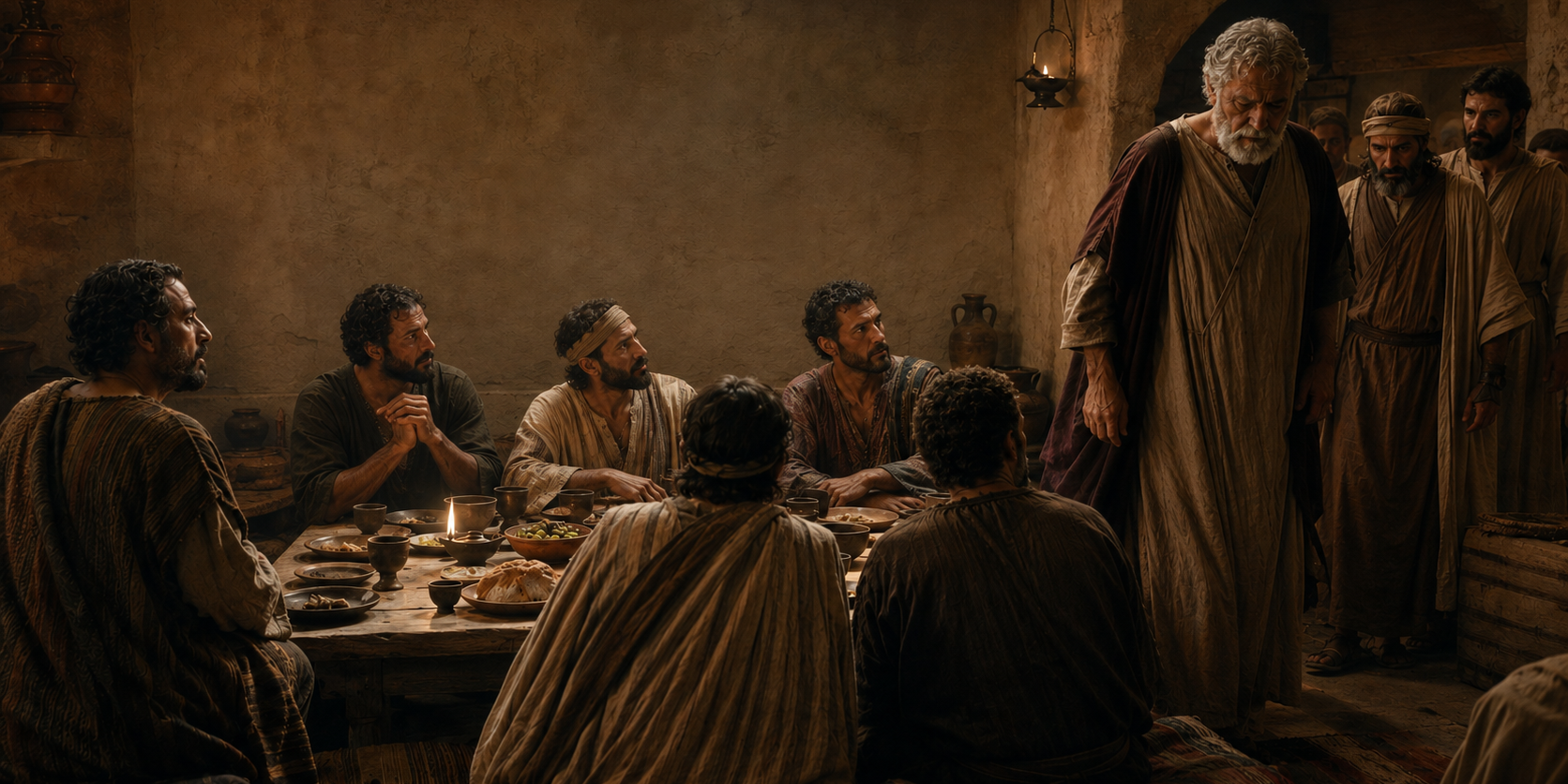
Paul moves from a Greek whose body became the object of attempted compulsion to a community in which Jewish and Gentile believers had been sharing a table. Peter initially participates without apparent hesitation.
“For prior to the coming of certain men from James, he used to eat with the Gentiles” (Gal. 2:12).
Something changes when these men arrive.
“But when they came, he began to withdraw and separate himself, fearing those from the circumcision” (Gal. 2:12).
Paul’s description is physical and social. Peter had been eating with Gentiles. Men associated with James arrive. Peter becomes afraid of “those from the circumcision,” and he withdraws from the Gentiles.
It is important here not to supply details that Paul himself never gives us. Nothing in Galatians says that the controversy concerned what food was being served. Paul does not mention pork, clean and unclean animals, food preparation, meat sacrificed to idols, or dietary regulations of any kind. Indeed, nowhere in the entire letter does food become the subject of the controversy.
The assumption that dietary law caused the separation is usually imported because the dispute occurred around a meal. Paul himself tells us what changed. Peter does not stop eating a particular kind of food. He stops eating with particular people.
The issue is not what is on the table. It is who is sitting at the table.
Acts provides an unusually close parallel because Luke describes an earlier controversy involving Peter, Gentiles, circumcision, and shared meals. When Peter enters the house of Cornelius, he explains the social difficulty directly:
“You yourselves know how unlawful it is for a man who is a Jew to associate with a foreigner or to visit him; and yet God has shown me that I should not call any man unholy or unclean” (Acts 10:28).
Whatever role the animals play within Peter’s vision, Peter himself applies the revelation to people. God has shown him that he “should not call any man unholy or unclean.” When Peter subsequently returns to Jerusalem, the criticism brought against him makes the point even more explicit:
“You went to uncircumcised men and ate with them” (Acts 11:3).
The accusation identifies both the people and the offense. They were uncircumcised men, and Peter ate with them.
That earlier episode makes the events at Antioch immediately recognizable. Peter is once again eating with Gentiles. Once again circumcision becomes relevant. But this time, when men associated with James arrive, Peter retreats. He fears “those from the circumcision” and separates himself from his Gentile table companions.
This social boundary is not something we have to reconstruct solely from Christian literature. Roman observers noticed it as well. Tacitus, writing from an openly hostile perspective toward Jews, includes an extraordinarily relevant observation in his description of Jewish customs:
“They sit apart at meals, and they sleep apart” (Tacitus, Histories 5.5).
Tacitus then turns immediately to circumcision, which he describes as a practice adopted “as a mark of difference from other men” (Tacitus, Histories 5.5). He further observes that those who entered Jewish life adopted the same practice.
Tacitus is hardly an objective ethnographer. His account is filled with Roman prejudice, caricature, and hostility toward Jewish customs. But that is precisely why this limited observation is useful. He has no interest in defending Luke or explaining Paul. He is simply describing what Jewish social distinctiveness looked like to an outsider, and separation at meals appears alongside circumcision as a marker distinguishing Jews from other peoples.
Juvenal supplies another Roman glimpse of the same social world. In his fourteenth Satire he mocks Gentiles who increasingly adopt Jewish practices until “in time they take to circumcision,” learn Jewish law, and identify socially with fellow circumcised Jews (Juvenal, Satire 14.96 to 106). Juvenal, like Tacitus, is hostile and should be handled accordingly. But his caricature assumes that circumcision marks a significant movement across the communal boundary into Jewish life.
None of this means that every Jew everywhere refused every meal with every Gentile. Jewish practice across the Roman Mediterranean was too diverse for such a sweeping claim. The evidence establishes something narrower and more useful. Separation from Gentiles at meals was a recognizable Jewish social practice, and circumcision was a recognizable marker that determined who was allowed at their table.
That is enough to make the scene at Antioch historically intelligible without inventing an unmentioned menu.
Peter had been eating with Gentiles. He feared those from the circumcision. He withdrew from the Gentiles. Then something even more serious happened.
“The rest of the Jews joined him in hypocrisy, with the result that even Barnabas was carried away by their hypocrisy” (Gal. 2:13).
Peter’s decision reorganizes the community. Other Jewish believers follow him, including Barnabas. A community that had been eating together is now visibly divided between Jews and Gentiles. Paul sees more than personal inconsistency in Peter’s behavior. The separation communicates something about the status of the Gentiles who have been left behind.
That is why Paul’s accusation in the next verse is so important:
“But when I saw that they were not straightforward about the truth of the gospel, I said to Cephas in the presence of all, ‘If you, being a Jew, live like the Gentiles and not like the Jews, how is it that you compel the Gentiles to Judaize?’” (Gal. 2:14).
The verb “compel” should sound familiar because Paul has already used it earlier in the chapter.
“But not even Titus, who was with me, though he was a Greek, was compelled to be circumcised” (Gal. 2:3).
Now Peter is accused of compelling Gentiles to Judaize.
“How is it that you compel the Gentiles to Judaize?” (Gal. 2:14).
The correspondence is difficult to treat as accidental. Titus is a Greek whom some sought to compel to be circumcised. At Antioch, Gentiles are being compelled to Judaize. Paul has not wandered into a second, unrelated controversy. Both episodes concern pressure being placed upon Gentiles to cross a Jewish communal boundary.
The verb Paul uses in Galatians 2:14 is ἰουδαΐζειν. English translations frequently render it “live like Jews,” which communicates part of the idea but can also soften the force of the ancient terminology. Paul uses a verb formed directly from Jewish identity: to Judaize.
Josephus gives us particularly useful evidence for how this language could function in the first century. During the Jewish revolt in 66 CE, the Roman commander Metilius attempted to save his life by promising μέχρι περιτομῆς ἰουδαΐσειν, to Judaize even to the point of circumcision (Josephus, Jewish War 2.454). English translations consequently render the expression with language such as turning Jew and being circumcised.
Josephus does not prove that Paul must use the verb with precisely the same nuance in every respect. Context determines meaning, and we should not force one author’s usage mechanically upon another. But Josephus establishes the linguistic world in which Paul writes. Judaizing could describe movement into Jewish identity, and circumcision could stand at the decisive bodily point of that movement.
That makes Paul’s own sequence particularly striking. Within eleven verses we move from a Greek who was not “compelled to be circumcised” to Gentiles being “compelled to Judaize.” The usual English rendering “live like Jews” can make the latter sound as though Peter were merely pressuring Gentiles to adopt certain Jewish habits. Paul’s language, read alongside the circumcision controversy he has already introduced, points toward something more substantial. The question concerns what these Gentiles must become.
This also explains how Peter could compel Gentiles to Judaize without ever issuing a verbal command to be circumcised. Paul does not say Peter preached circumcision at Antioch. Peter withdrew from their table.
But withdrawal itself can exert social pressure.
Before the men from James arrived, Jewish and Gentile believers shared the same table. Peter’s participation demonstrated that Gentiles could remain Gentiles and nevertheless enjoy fellowship with Jewish believers in the Messiah. Once Peter withdrew and the other Jews followed him, that social reality was reversed. The Gentiles now found themselves separated precisely along the boundary between Jew and Gentile.
The solution practically announced itself. If remaining an uncircumcised Gentile placed someone on the wrong side of the boundary, crossing the boundary would remove the problem. Judaize. Enter Jewish identity. For Gentile males, circumcision provided the decisive bodily mark of that transition.
Peter may never have verbally demanded this. Paul’s accusation concerns what his behavior communicated.
The connection with Acts 11 becomes especially powerful here. Peter had previously been accused in Jerusalem because:
“You went to uncircumcised men and ate with them” (Acts 11:3).
At Antioch, Peter is again eating with Gentiles until fear of “those from the circumcision” causes him to withdraw (Gal. 2:12). Paul then interprets the social effect of that withdrawal:
“How is it that you compel the Gentiles to Judaize?” (Gal. 2:14).
The pieces fit together without requiring food regulations to be inserted into the narrative. The boundary is between circumcised Jews and uncircumcised Gentiles. Eating together crosses that boundary. Withdrawal reconstructs it. Once reconstructed, the boundary places pressure upon those left outside to cross it.
Paul then continues his rebuke by taking up the very distinction Peter’s behavior has just reinforced:
“We are Jews by nature and not sinners from among the Gentiles” (Gal. 2:15).
This should not be heard as Paul calmly endorsing a moral hierarchy in which Jews are righteous people and Gentiles are sinners. He takes up the conventional language of the boundary itself. We are the Jews by birth. They are the “Gentile sinners.” Peter has just made that distinction socially visible by withdrawing from the Gentiles and gathering with the Jews.
Paul immediately turns the apparent privilege against Peter.
“Nevertheless knowing that a person is not justified by works of the Law but through faith in Jesus Christ, even we have believed in Christ Jesus” (Gal. 2:16).
The force falls heavily upon “even we.”
Even we Jews by birth. Even we who were not born among the “Gentile sinners.” Even we who already possessed Jewish ancestry, circumcision, and the Law. Even we believed in Christ Jesus.
Whatever precise meaning we eventually assign to the disputed expression “works of the Law,” Paul’s immediate rhetorical point does not depend upon resolving every aspect of that debate. Peter and Paul are Jews, and yet Peter and Paul need Jesus.
That turns the social hierarchy Peter has reconstructed on its head. Peter’s behavior suggests that the Gentile occupies a deficient position because he stands outside Jewish identity. Paul reminds Peter that being born inside Jewish identity did not provide the standing now under discussion.
The Gentile sinner needs the Messiah.
So does the Jew by birth.
Paul therefore begins with the language of apparent privilege:
“We are Jews by nature and not sinners from among the Gentiles” (Gal. 2:15).
Then he immediately undercuts what that privilege can accomplish:
“Even we have believed in Christ Jesus” (Gal. 2:16).
Paul is not denying that Peter is Jewish or that the people from whom Peter withdrew are Gentiles. He is denying that being Jewish gives Peter a superior standing before God that the Gentile can acquire only by becoming Jewish. Peter himself already knows otherwise. His own faith in the Messiah confesses otherwise.
That is what makes his behavior so contradictory. Through his withdrawal Peter acts as though the Gentiles need to move toward his ethnic position. Paul reminds him that Peter’s ethnic position did not provide what Peter himself sought in Christ.
The Jew does not stand above the Gentile sinner simply because he was born a Jew. The Gentile does not need to become a Jew in order to obtain what the Jew himself receives only through Christ.
Paul then considers the implication created by Peter’s withdrawal:
“But if, while seeking to be justified in Christ, we ourselves have also been found sinners, is Christ then a servant of sin? Far from it!” (Gal. 2:17).
The question reaches back naturally to the distinction Paul has just invoked. He began with “Jews by nature and not sinners from among the Gentiles.” Yet Peter and Paul had sought justification in Christ, and the life they had learned in Christ allowed them to share fellowship with uncircumcised Gentiles. Peter himself had been eating with them.
His withdrawal now places a troubling verdict upon that previous behavior. If eating with uncircumcised Gentiles meant that Peter and Paul had become sinners, then Christ had led them into sin. The shared life created through Christ would have violated the boundary that Peter was now attempting to restore. Christ himself would therefore become, in Paul’s deliberately shocking language, “a servant of sin.”
Paul rejects that conclusion immediately:
“Far from it!” (Gal. 2:17).
The problem does not lie in the boundary having been crossed. The problem lies in treating its destruction as though it had been wrong. That is where Paul’s next statement becomes especially important:
“For if I rebuild what I have once destroyed, I prove myself to be a transgressor” (Gal. 2:18).
The rebuilding language does more than describe the restoration of a social boundary. Rebuilding renders a verdict upon the act of destruction. If Paul restores the distinction between Jews and Gentiles, he implicitly admits that tearing it down was a transgression. But that destruction belonged to the life he had embraced through Christ. To condemn it would therefore implicate Christ as the one who had led him into sin.
Paul reverses the accusation. Christ is not the servant of sin for bringing Jews and Gentiles into fellowship. The transgressor is the person who rebuilds the distinction Christ taught them to abandon.
Read within the Antioch confrontation, this is precisely what Peter’s behavior threatens to do. Peter had been eating with Gentiles. Jewish and Gentile believers had shared a table without requiring those Gentiles first to acquire Jewish identity. But when Peter withdrew and the other Jews followed him, the old distinction became socially visible again. The Gentiles once more found themselves outside.
Peter’s behavior therefore communicates more than separation. It suggests that the shared table had been a mistake. It implies that the distinction between circumcised Jews and uncircumcised Gentiles should never have ceased to govern their fellowship. Peter is not merely returning to an older social arrangement. By rebuilding that arrangement, he is treating the life created through Christ as though it had produced transgression.
Paul refuses that conclusion. If he were to rebuild what he had destroyed, he would not prove Christ guilty. He would prove himself to be the transgressor.
Paul then explains why he cannot return to the identity represented by that boundary:
“For through the Law I died to the Law, so that I might live to God. I have been crucified with Christ; and it is no longer I who live, but Christ lives in me; and the life which I now live in the flesh I live by the faith of the Son of God, who loved me and gave Himself up for me” (Gal. 2:19–20).
These words stand precisely where they do because Paul is not pausing the Antioch argument to give an abstract account of personal salvation. He is explaining why rebuilding the former distinction would contradict the life now created through Christ.
Peter was acting as though Jewish flesh still determined table fellowship. The Galatians were being persuaded that circumcised flesh would complete their standing in Abraham’s family. Paul answers both errors with the same confession: “I have been crucified with Christ.” The person whose standing was defined by physical descent has died with the Messiah.
Yet Paul immediately adds that he still lives “in the flesh” (Gal. 2:20). He remains physically Jewish. His ancestry and circumcision have not disappeared, nor has he ceased living as a Jew. What has changed is the authority by which that life is defined. “The life which I now live in the flesh I live by the faithfulness of the Son of God” (Gal. 2:20). Jewish flesh remains, but it no longer governs his standing before God or determines his fellowship with Gentiles. The faithful Messiah now defines how Paul lives within that flesh.
Peter’s error was therefore not that he remained Jewish. Paul remained Jewish as well. Peter’s error was allowing Jewish flesh to govern the table. Paul answers that the Jewish life he continues to live is now ordered by the faithfulness of the Messiah who loved him and gave himself for him. Messiah does not erase Paul’s Jewish identity. Messiah determines how that identity must now be lived.
This also gives Paul’s statement, “through the Law I died to the Law,” its place within the argument. The repetition in English can make it appear certain that Paul refers to the Law of Moses in precisely the same sense both times. The Greek, however, reads διὰ νόμου νόμῳ, “through law, to law,” without the article in either expression. The grammar does not require both uses of “law” to have exactly the same referent.
The first use appears to refer to the Law of Moses. The second refers more naturally within this argument to the legal and social rule Peter himself describes in Acts: “You yourselves know how unlawful it is for a man who is a Jew to associate with a foreigner or to visit him” (Acts 10:28). Paul is saying that through the Law, now read in light of the Messiah, he died to the law of separation that Peter was attempting to rebuild.
The Law of Moses nowhere commands Jews to refuse ordinary fellowship with every uncircumcised Gentile. It commands Israel to love the foreigner and to treat the foreigner residing among them as the native (Lev. 19:34; Deut. 10:19). It can even speak of “one law and one ordinance” for Israel and the foreigner residing among them (Num. 15:15–16). These passages do not erase every distinction between Israelites and foreigners, but they do show that the comprehensive social separation enacted by Peter cannot simply be identified with obedience to Moses.
Paul therefore did not die to Scripture, righteousness, or obedience. Through the Law, interpreted in light of the Messiah, he died to the legal and social boundary that made Jewish flesh the condition of fellowship and covenant standing. That boundary is precisely what Peter rebuilds at Antioch and what the circumcision teachers seek to inscribe upon Gentile flesh in Galatia.
Paul completes the argument by stating what Peter’s reconstruction of the boundary would ultimately imply:
“I do not nullify the grace of God, for if righteousness comes through law, then Christ died needlessly” (Gal. 2:21).
Paul is still answering Peter. He has not moved into an abstract dispute about whether people can earn salvation through moral effort. Peter’s withdrawal restored the legal and social boundary between Jews and Gentiles. It implied that the standing created through the Messiah was insufficient unless Gentiles crossed that boundary and entered Jewish identity.
Paul calls that a nullification of the grace of God. If righteousness can be established through the law of separation, through the identity structure that privileged circumcised Jewish flesh, then the death of the Messiah accomplished nothing necessary. Peter’s conduct says, in effect, that Christ may bring Gentiles near, but Jewish identity still determines whether they belong at the table.
The progression is exact. Rebuilding the boundary treats its destruction as sinful and threatens to make Christ a servant of sin (Gal. 2:17–18). Paul has died to that boundary and now lives in Jewish flesh according to the faithfulness of the Messiah (Gal. 2:19–20). To restore the boundary would nullify the grace of God by making righteousness depend upon the identity marked in the flesh rather than upon what God has accomplished through the Messiah (Gal. 2:21).
Verse 21 therefore belongs completely to the Antioch argument. Peter’s withdrawal does not merely create inconsistency at a meal. It communicates that Christ is insufficient to establish the standing of Gentiles without circumcision and Jewish identity. For Paul, that implication is intolerable. If the boundary can accomplish what Christ came to accomplish, then Christ died needlessly.
The sequence is remarkably tight. Peter rebuilds the distinction between Jewish and Gentile flesh. By doing so, he implies that its destruction was sinful and threatens to make Christ responsible for that sin. Paul rejects the accusation and identifies the person rebuilding the distinction as the transgressor. He then declares that the person formerly defined by that distinction has been crucified with Christ. The Galatians are next asked whether they intend to complete by flesh what began by the Spirit (Gal. 3:3). Finally, Paul identifies that flesh concretely as the circumcision in which his opponents wish to boast (Gal. 6:12–13).
Galatians 2:17–20 therefore forms the theological bridge between the Jewish flesh Peter privileged at Antioch and the Gentile flesh being circumcised in Galatia. Paul’s answer to both is that covenant life is no longer established by the identity written upon the flesh, but by participation in the faithful Messiah.
The movement through the chapter is therefore remarkably controlled. Titus is a Greek whom some wish to compel to be circumcised. Peter eats with Gentiles until fear of those from the circumcision causes him to withdraw. Paul identifies the effect of that withdrawal as compelling Gentiles to Judaize. Peter’s behavior appears to privilege the status of those who are Jews by birth, but Paul reminds him that “even we” Jews believed in Christ. Jewish birth does not provide the standing that the Gentile supposedly lacks. By rebuilding that boundary, Peter treats its destruction as though it had been sinful and threatens to implicate Christ in that sin. Paul instead identifies the person rebuilding the distinction as the transgressor, because the identity defined by Jewish flesh has been crucified with Christ.
Paul has turned Peter’s table completely around.
The problem is no longer the uncircumcised Gentile sitting beside the Jew. The problem is the Jew who gets up..