Corinth was not merely a city. It was a symbol. To name Corinth in the ancient world was to summon a dense world of wealth, ports, temples, sailors, strangers, appetite, luxury, Aphrodite, and sexual commerce. Its geography made it powerful. Its reputation made it dangerous. The city sat on the Isthmus, commanding movement between two seas. Travelers passed through Corinth. Merchants passed through Corinth. Sailors passed through Corinth. Money passed through Corinth. And in the ancient world, where money, gods, meals, vows, and bodies gathered together, religion was never far away.
Strabo explains the city’s wealth in commercial terms:
“Corinth is called ‘wealthy’ because of its commerce, since it is situated on the Isthmus and is master of two harbours.”
Strabo, Geography 8.6.20
But Corinth’s fame was not merely commercial. Its wealth had a goddess. Its pleasures had a cultic grammar. Corinth was associated above all with Aphrodite, the goddess of love, desire, persuasion, and sexual power. Pausanias, describing the sacred geography of the city, says:
“On the summit of Acrocorinth is a temple of Aphrodite.”
Pausanias, Description of Greece 2.5.1
That image matters. Aphrodite stood above the city. Below were the harbors, the markets, the banquet rooms, the temples, the houses, the bodies, and the traffic of empire. Above it all was the goddess of desire. This is not a neutral setting. It is a city where sex, money, worship, civic life, and divine presence could be imagined together.
Strabo gives the most famous testimony:
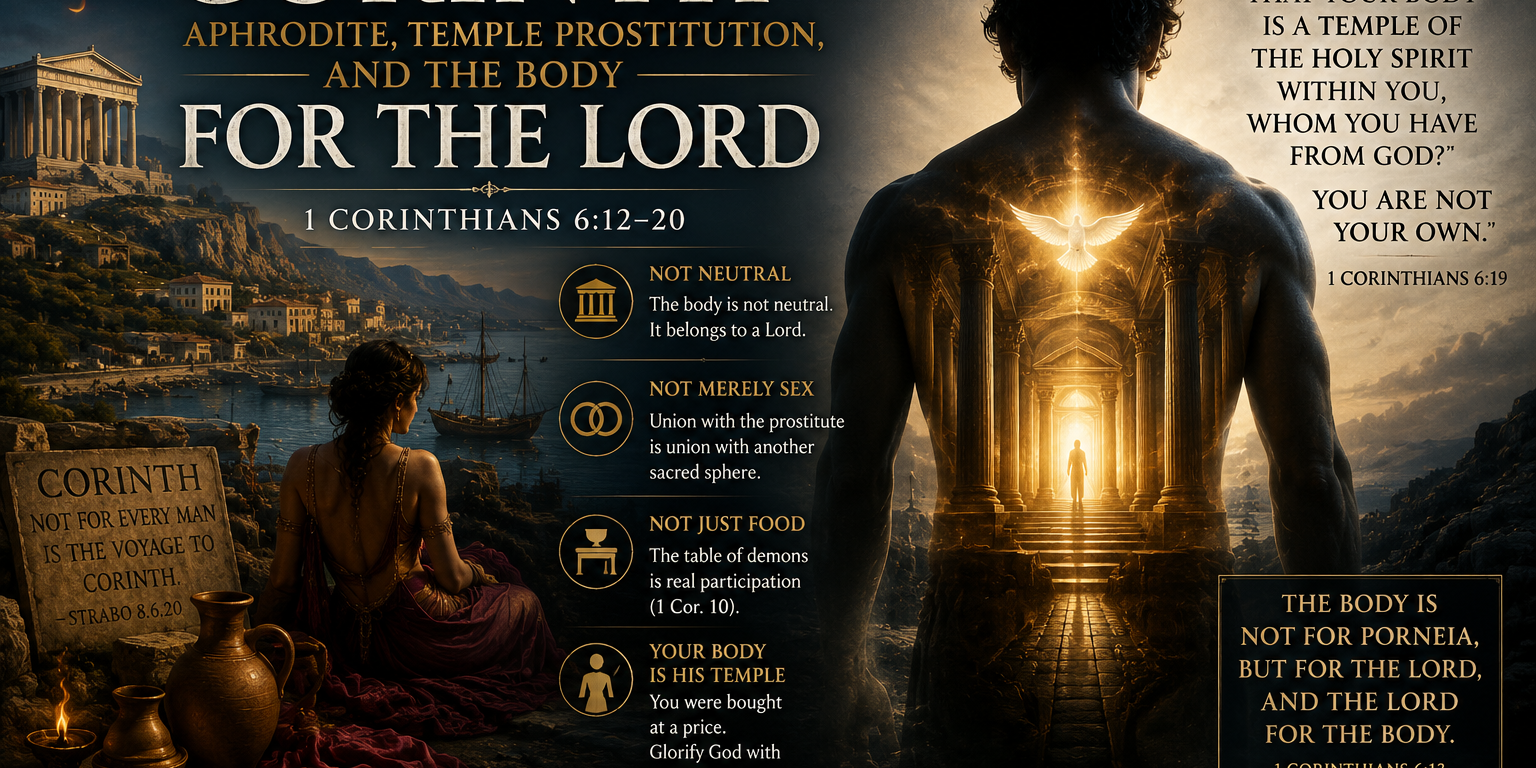
“The temple of Aphrodite was so rich that it owned more than a thousand temple-slaves, courtesans, whom both men and women had dedicated to the goddess. And therefore it was also on account of these women that the city was crowded with people and grew rich; for instance, the ship-captains freely squandered their money, and hence the proverb, ‘Not for every man is the voyage to Corinth.’”
Strabo, Geography 8.6.20
The power of this quotation is not simply that Corinth had prostitutes. Ancient cities had prostitutes. The point is that Corinth’s prostitutes could be remembered in relation to Aphrodite, dedication, temple wealth, sailors, travel, and sacred economy. Strabo binds together the goddess, the sanctuary, the women, the money, and the city’s fame. Corinth’s erotic life is not presented as a private underground economy. It stands under the sign of Aphrodite.
Athenaeus preserves the same atmosphere when he reports that Corinthian courtesans could be summoned into the city’s prayers to Aphrodite. According to him, when the Corinthians prayed to Aphrodite concerning serious matters, they invited as many courtesans as possible to join in the supplication.
Athenaeus, Deipnosophistae 13.573c to 573d
Again, the courtesans are not merely private sexual figures. They appear inside the religious imagination of the city. They stand near the goddess. They participate in supplication. They belong to a world where erotic power and divine power touch.
Athenaeus also preserves a fragment of Pindar connected with Xenophon of Corinth, who was said to have dedicated women to Aphrodite. In one common translation, Pindar addresses the women this way:
“O hospitable girls, servants of Persuasion in wealthy Corinth, who burn the golden drops of fresh frankincense, often flying in thought to Aphrodite, the heavenly mother of loves…”
Pindar, Fragment 122, preserved in Athenaeus, Deipnosophistae 13.573e
This is not the language of a modern secular brothel. It is the language of incense, Persuasion, Aphrodite, hospitality, wealthy Corinth, and sacred dedication. These women are “servants of Persuasion.” Their sexuality is not imagined apart from the goddess. It is inside her world.
This reputation was so strong that Corinth’s name generated a verb: κορινθιάζεσθαι, korinthiazesthai, “to Corinthianize,” to act like a Corinthian. In ancient usage, it could carry the sense of sexual indulgence, luxury, and behavior associated with courtesans and prostitution. Corinth was not only a place. It became a shorthand for a kind of embodied life.
This is the black backdrop. Not sex in the abstract. Not prostitution in the abstract. Corinth as a temple world. Corinth as Aphrodite’s city. Corinth as a place where bodies, gods, tables, money, and lordship met.
Against that backdrop, Paul’s words in 1 Corinthians 6 do not sound like a generic warning about sexual immorality. They sound like a confrontation with cultic sexual participation.
Paul begins:
“All things are lawful for me,” but not everything is beneficial.
“All things are lawful for me,” but I will not be controlled by anything.
“Food is for the stomach and the stomach is for food, but God will do away with both.”
The body is not for sexual immorality, but for the Lord, and the Lord for the body.
1 Corinthians 6:12–13
The opening is the key. Paul does not begin with an abstract sex rule. He begins with Corinthian slogans.
“All things are lawful for me.”
This slogan appears again later in the letter:
“All things are lawful,” but not all things are beneficial.
“All things are lawful,” but not all things build up.
1 Corinthians 10:23
That repetition is not accidental. In chapter 6, the slogan appears when Paul confronts union with a prostitute. In chapter 10, the same slogan appears when Paul confronts idol food. The same Corinthian argument is being used in two temple contexts. Paul is not dealing with two unrelated issues, first sex and then later idols. He is dealing with one Corinthian theology of freedom, appetite, and bodily indifference. The Corinthians are using the same logic to justify two forms of cultic participation: temple sex and temple food.
They say, “All things are lawful.”
Paul says, “Not all things are beneficial.”
They say, “All things are lawful.”
Paul says, “I will not be placed under the authority of anything.”
This is the irony in Paul’s rebuttal. The Corinthians are calling this freedom. Paul calls it subjugation. They think freedom means the right to take the body into the temple, join it to the prostitute, and leave unchanged. Paul sees the act differently. Freedom that places the body under another lord is not freedom. It is bondage.
His answer is devastating because he does not merely say, “I will not be controlled by my desires.” He says, in effect, “I will not allow my body to be brought under another authority.” The issue is not only appetite. The issue is jurisdiction. Who has the right to claim the body? Who has authority over it? To whom does it belong?
In a temple setting, those questions are unavoidable. Union with the prostitute is not merely sexual release. It is bodily submission to another sacred order. It places the body that belongs to Christ within a rival sphere of authority. The Corinthians see autonomy. Paul sees transfer. They see liberty. Paul sees another lord making a claim.
They say, “Food is for the stomach and the stomach is for food.”
Paul says, “The body is for the Lord.”
The movement is deliberate. Paul starts with food because food is one of the major temple issues in Corinth. He will address it directly in chapters 8 to 10. The Corinthians know the idol food debate. They know the argument: idols are nothing, food is food, the enlightened are free, the body eats and digests, and no spiritual damage is done. Paul begins with that food logic because the same logic is being used for cultic sex.
The Corinthians are reasoning from appetite:
Food belongs to the stomach.
Sex belongs to the body.
The body has appetites.
Appetites are temporary.
We are free.
Idols are nothing.
Therefore, temple food and temple sex are harmless.
Paul breaks the argument at the word body.
He grants the temporary character of food and stomach, but he refuses to let them place the body in that same category:
“The body is not for sexual immorality, but for the Lord, and the Lord for the body.”
1 Corinthians 6:13
But even the phrase “sexual immorality” can mislead if it is heard too generally. In this passage, porneia is not an abstract category floating above the text. Paul identifies its concrete form almost immediately: joining oneself to a prostitute. And in this Corinthian setting, with this food slogan, this temple language, this Aphrodite filled backdrop, the prostitute in view is not merely a prostitute in general. She belongs to the temple world. She represents another sacred order. She is the bodily point of contact with another lordship.
So Paul’s claim is sharper than “the body is not for immoral sex.”
His claim is:
The body is not for cultic sexual union with another god’s woman. The body is for the Lord.
That is why the next phrase matters so much:
“and the Lord for the body.”
Paul does not say merely that the soul belongs to the Lord, or the spirit belongs to the Lord, or the mind belongs to the Lord. He says the body belongs to the Lord, and the Lord is for the body. Christ’s claim is not spiritualized. It is embodied. The body is not available for Aphrodite because the body has already been claimed by Christ.
Then Paul invokes resurrection:
“Now God indeed raised the Lord and he will raise us by his power.”
1 Corinthians 6:14
This is not a theological aside. It is the collapse of the Corinthian argument. They have placed the body in the category of temporary appetite: food, stomach, sex, body, destruction. Paul says no. The body is not like food and stomach. The body belongs to resurrection. God raised the Lord bodily, and God will raise believers bodily. Therefore the body is not disposable religiously. It cannot be treated as a neutral instrument of appetite.
The body has a destiny. The body has a Lord. The body has already been claimed.
Then Paul asks:
“Do you not know that your bodies are members of Christ? Should I take the members of Christ and make them members of a prostitute? Never!”
1 Corinthians 6:15
This is the center of the passage.
Paul does not say, “Do you not know that prostitution is morally wrong?” He says, “Do you not know that your bodies are members of Christ?”
That is not generic sexual ethics. That is incorporation theology. The believer’s body is part of Christ’s body. The body is not owned by the self. It is not a detachable instrument. It is not a private possession. It is a member of Christ.
So the horror is not simply that a man has broken a sexual rule. The horror is that he has taken Christ’s members and joined them to another sacred body. He has brought Christ’s body into another god’s sexual economy. He has made the Lord’s members members of the prostitute.
The prostitute, in this argument, is not merely an occasion for lust. She is the rival point of incorporation. In a cultic setting, the prostitute does double work. She is an actual woman, but she is not only an actual woman. She belongs to Aphrodite’s world. She is attached to the goddess’s sacred economy. To join oneself to her is, within that religious imagination, to enter the sphere of the deity she serves. The man does not simply take a body to himself. He takes to himself a body already marked by another sacred claim. He touches Aphrodite’s world through Aphrodite’s woman. The union is not private. It is representative. It is not merely sexual. It is cultic.
She is the other body to which Christ’s members are being joined. In a Corinthian temple setting, she is not simply “a woman.” She functions as the embodied representative of another cultic sphere. To join her is to enact a rival union.
That is why Paul’s “Never!” is so explosive. He is not reacting to mere impropriety. He is reacting to sacrilege.
Then Paul explains the mechanics of the act:
“Or do you not know that anyone who is united with a prostitute is one body with her? For it is said, ‘The two will become one flesh.’”
1 Corinthians 6:16
Paul quotes Genesis 2:24. This is crucial. He refuses the Corinthian attempt to treat sex as a passing appetite. Sexual union does something. It joins. It makes “one body.” It creates embodied participation.
The Corinthians may have wanted to say: “It is only the body.”
Paul says: “Exactly. And the body is for the Lord.”
They may have wanted to say: “It is only sex.”
Paul says: “No. The two become one flesh.”
They may have wanted to say: “It is only a prostitute.”
Paul says: “No. You are making Christ’s members members of her.”
And in the context of temple prostitution, that means more than union with an individual woman. It means bodily participation in the sacred order she serves. It means crossing into another sphere of lordship through the body. It means that the body claimed by Christ is being placed under the authority of another sacred power.
Paul then sets the rival union in direct contrast with union with Christ:
“But the one united with the Lord is one spirit with him.”
1 Corinthians 6:17
This is not a contrast between physical union with the prostitute and spiritual union with Christ, as though the body does not matter. Paul has already made the opposite point: the body belongs to the Lord and will be raised. The contrast is between two forms of participation.
Joined to the prostitute: one body with her.
Joined to the Lord: one spirit with him.
The two unions are incompatible because the body cannot serve two sacred claims. Christ’s members cannot be incorporated into another god’s sphere. The Spirit’s temple cannot be taken into Aphrodite’s economy.
Then Paul commands:
“Flee sexual immorality!”
1 Corinthians 6:18
Again, “sexual immorality” here must be read in context. Paul is not pausing to discuss every possible sexual sin. He is naming the specific cultic sexual act under discussion. In this passage, to “flee porneia” means to flee the temple prostitution practice that would join Christ’s members to another sacred order.
And this command has a twin later in the letter:
“Therefore, my beloved, flee from idolatry.”
1 Corinthians 10:14
These are paired commands.
In chapter 6: flee temple sex.
In chapter 10: flee temple food.
In chapter 6: do not join Christ’s members to the prostitute.
In chapter 10: do not drink the Lord’s cup and the cup of demons.
In chapter 6: the issue is one body union.
In chapter 10: the issue is table participation.
Paul is not moving from sexual morality to idolatry as separate topics. He is confronting the Corinthian temple world in two forms: sacred sex and sacred meals.
This makes the difficult line in 6:18 more coherent:
“Every sin a person commits is outside of the body,” but the immoral person sins against his own body.
1 Corinthians 6:18
This likely reflects, or at least engages, the Corinthians’ bodily logic. They want to place sin “outside” the true self. The body is external. Bodily acts do not reach the spiritual person. Food enters the stomach. Sex touches the body. God will do away with both. All things are lawful.
Paul rejects that anthropology. The body is not outside the person. The body is where allegiance is enacted. The body is where union happens. The body is where Christ has members. The body is where the Spirit dwells. The body is where worship or apostasy takes place.
Then Paul reaches the climax:
“Or do you not know that your body is the temple of the Holy Spirit who is in you, whom you have from God, and you are not your own?”
1 Corinthians 6:19
This is not metaphor as ornament. This is the controlling category of the whole passage.
The issue is temple prostitution; Paul answers with a counter temple.
In Corinth, Aphrodite has her temple.
Paul says the Spirit has his.
In Corinth, bodies may be dedicated to the goddess.
Paul says your body has already been claimed by God.
In Corinth, the man may enter a sacred sexual union through the prostitute of another cult.
Paul says you yourself are sacred space.
In Corinth, the sexual act may be treated as participation in Aphrodite’s sphere.
Paul says the body is already the sanctuary of the Holy Spirit.
This is why the temple language belongs at the end. It reveals what the whole passage has been about from the beginning. Paul is not decorating a sex ethic with religious imagery. He is exposing the act as a temple violation. The man who joins himself to the temple prostitute is not merely misusing his sexuality. He is taking the Spirit’s temple into another god’s domain.
Then Paul says:
“For you were bought at a price. Therefore glorify God with your body.”
1 Corinthians 6:20
“You were bought” is ownership language. It is transfer language. It is lordship language. The believer has changed masters. The body is no longer available to the old gods, the old temples, the old meals, the old sexual rites, the old powers.
“Glorify God with your body” is worship language. Paul’s answer to temple prostitution is not merely abstinence. It is worship. The body must glorify God because the body has become God’s temple. The body cannot glorify God while being joined to the prostitute of another sacred order.
This is why the passage must not be reduced to general sexual morality. The categories are not sex and prostitution first, with cultic imagery added afterward. The categories are cultic from the beginning: temple, lordship, membership, union, belonging, participation, sacred ownership, and worship.
The word “prostitute” in this passage is not functioning generically. Paul’s argument makes the prostitute cultic. She is the forbidden point of union because she belongs to the rival sacred order. She is the sexual equivalent of the idol table in chapter 10.
That is why the movement of the letter matters so much.
In chapter 6, Paul confronts temple prostitution.
In chapters 8 to 10, Paul confronts temple food.
In both cases, the Corinthians appeal to freedom.
“All things are lawful for me.”
1 Corinthians 6:12
“All things are lawful.”
1 Corinthians 10:23
In both cases, Paul denies that freedom permits participation.
In chapter 6:
“I will not be placed under the authority of anything.”
1 Corinthians 6:12
In chapter 10:
“I do not want you to be participants with demons.”
1 Corinthians 10:20
In chapter 6, the body is joined to the prostitute:
“The one united with a prostitute is one body with her.”
1 Corinthians 6:16
In chapter 10, the worshiper is joined to the altar and table:
“The cup of blessing that we bless, is it not a participation in the blood of Christ? The bread that we break, is it not a participation in the body of Christ?”
1 Corinthians 10:16
In chapter 6, Paul says Christ’s members cannot be made members of a prostitute.
In chapter 10, Paul says:
“You cannot drink the cup of the Lord and the cup of demons. You cannot partake of the table of the Lord and the table of demons.”
1 Corinthians 10:21
The structure is exact.
Temple sex and temple food are parallel forms of cultic participation.
The Corinthians want to treat both as harmless because they are free and because idols are nothing. Paul answers that participation is real even when the idol is not God. The act joins. The body joins. The table joins. The cup joins. The bed joins. The temple joins.
In chapter 10, food is not just food when eaten at the table of demons.
In chapter 6, sex is not just sex when enacted with the woman who belongs to another god’s sacred world.
That is why Paul starts to address food in chapter 6 but confronts temple prostitution first. He begins with the food slogan because food is the Corinthians’ model for bodily indifference. They are treating cultic sex the way they treat idol food: as an appetite based act without spiritual consequence. Paul attacks the sexual form first because it reveals the body problem most starkly. Then he returns later to the meal form and completes the argument.
He begins at the table, but he turns first to the bed because both table and bed are temple sites.
The Corinthians say: food is for the stomach.
Paul hears what follows: and sex is for the body.
The Corinthians say: God will destroy both.
Paul says: no, God will raise the body.
The Corinthians say: all things are lawful.
Paul says: no freedom that places the body under another lord is Christian freedom.
The Corinthians say: idols are nothing.
Paul says: the table is participation with demons.
The Corinthians say: the prostitute is only a body.
Paul says: your body is a member of Christ.
The Corinthians say: appetite has no lord.
Paul says: the body is for the Lord.
This is the argument Paul develops across the letter. Paul is confronting a Corinthian sacramental imagination gone wrong. They understand participation when it benefits them. They understand meals. They understand temples. They understand bodies. They understand gods. But they want to carve out a space where Christian freedom allows them to continue old cultic practices without consequence. Paul refuses. He says that conversion to Christ has relocated the body. The body is no longer in Aphrodite’s jurisdiction. It is no longer available to the temple prostitute. It is no longer available to the idol table. It belongs to the risen Lord.
The diamond, then, is not simply this:
“Do not be sexually immoral.”
The diamond is this:
“The body is not for porneia, but for the Lord, and the Lord for the body.”
And in context, porneia is not generic immorality. It is the cultic sexual participation Paul is confronting: joining Christ’s body to the prostitute of another sacred order.
The body is not for that.
The body is for the Lord.
In Corinth, that sentence carries explosive force.
It confronts Aphrodite’s temple.
It confronts Corinthianizing.
It confronts the proverb, “Not for every man is the voyage to Corinth.”
It confronts the courtesans summoned to Aphrodite.
It confronts the food slogan.
It confronts the claim, “All things are lawful.”
It confronts the idea that the body is merely appetite.
It confronts the claim that Christ can have the spirit while Aphrodite has the body.
It confronts the illusion that subjugation to another sacred power can be called freedom.
Paul says no. Christ has the body.
Not merely the soul.
Not merely the inner self.
Not merely the worship service.
Not merely the confession of faith.
Christ has the body.
The body is a member of Christ.
The body will be raised.
The body is the Spirit’s temple.
The body has been bought.
The body must glorify God.
This is why Paul’s argument is so severe. He is not against the body. He is not against sex in some abstract sense. He is against idolatry, and in Corinth idolatry could happen through the body sexually as well as through the body at a meal. The mouth could drink the cup of demons. The body could join the prostitute of another god. Both acts were cultic. Both acts were participatory. Both acts contradicted the confession that Jesus is Lord.
The prostitute stands at the threshold between the man and the goddess’s sphere. Paul sees that threshold and refuses to let Christ’s members cross it.
So Paul’s argument can be stated plainly:
The Corinthians were treating temple prostitution as they treated temple food: a bodily act made harmless by knowledge, freedom, and the supposed nothingness of idols. Paul rejects the premise. The body is not religiously neutral. Sexual union is real union. Temple participation is real participation. What Corinth calls freedom, Paul exposes as bondage. Christ’s members cannot be joined to another god’s prostitute any more than the Lord’s cup can be joined to the cup of demons.
But Paul’s point is not that food is evil, nor is his point that sex is evil. The danger lies in cultic attachment. Food is God’s creation, but food eaten as temple participation is not just food. Sex is God’s creation, but sex enacted in the sphere of another deity is not just sex. The issue is not the material act by itself. The issue is the lordship into which the act is placed.
This is the force of 1 Corinthians 6.
Not sex in general.
Not prostitution in general.
Temple prostitution as rival lordship enacted through the body.
Paul’s answer is not, “Be more moral.”
Paul’s answer is:
You are not your own.
Paul’s final answer overturns the Corinthian slogan.
They begin with:
“All things are lawful for me.”
Paul ends with:
“You are not your own.”
The slogan begins with autonomy: “for me.”
Paul ends with ownership: “not your own.”
Between those two statements lies the whole conflict.
Corinth says: my body, my appetite, my freedom.
Paul says: Christ’s member, Spirit’s temple, bought body.
Corinth says: food is food, sex is sex.
Paul says: table is participation, union is participation.
Corinth says: idols are nothing.
Paul says: demons stand behind the table.
Corinth says: the prostitute is available.
Paul says: Christ’s members are not.
Corinth says: Aphrodite has her temple.
Paul says: your body is the temple of the Holy Spirit.
The diamond sparkles because the backdrop is black. Corinth is the backdrop: Aphrodite, courtesans, temple, sailors, wealth, sacred meals, sacred sex, and slogans of freedom. Against it Paul sets the body of the believer, claimed by the risen Lord.
The Corinthians mistake subjugation for freedom because they have mistaken the body for neutral territory. Paul will not allow that mistake to stand. The body is not neutral. The body belongs. The body serves. The body participates. The body is either placed under a rival authority or offered to the Lord who bought it.
The body is not for the temple prostitute.
The body is for the Lord.
And the Lord is for the body.