Just a little devotional thought this morning.
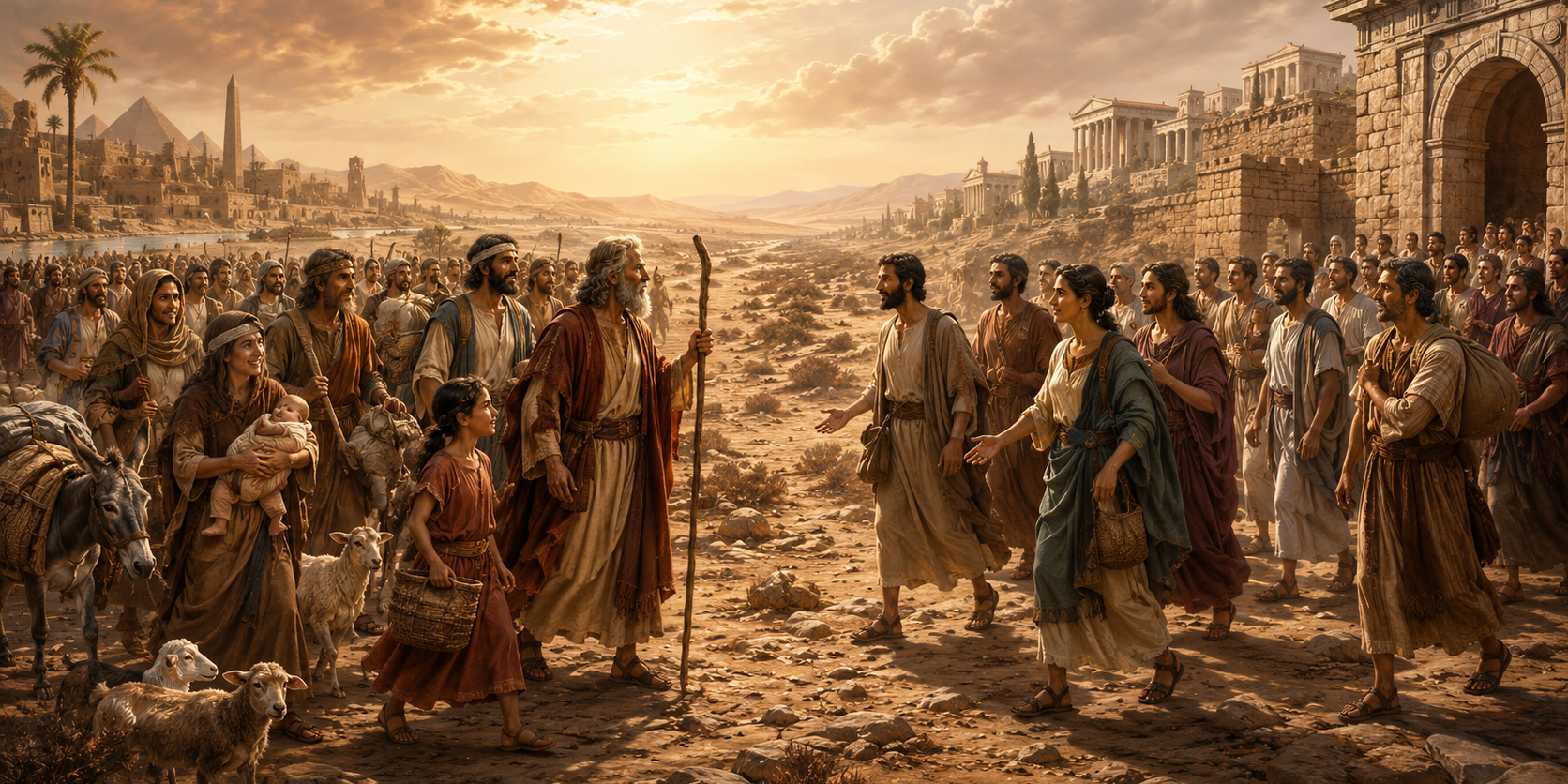
“Thus says the LORD, the God of Israel, ‘Let my people go, that they may hold a feast to me in the wilderness.’”
Exodus 5:1
“Let my people go, that they may worship me.”
Exodus 8:1
If worship were a private affair, Pharaoh would not have had to let Israel go. That is the question Exodus presses on us. Why could Israel not worship in Egypt? Why could they not pray in their houses after dark? Why could they not sing quietly when the day’s labor was over? Why could they not offer devotion inwardly, secretly, personally, in whatever narrow spaces Pharaoh’s economy still allowed them?
The answer is that, in the biblical world, worship was not first a feeling. It was not merely interior belief. It was not a private religious mood tucked into the margins of ordinary life. Worship was service, sacrifice, festival, assembly, movement, time, place, and allegiance. To worship a god was to belong to that god. It was to order one’s labor, one’s body, one’s calendar, and one’s community around that god’s claim.
This is why the demand to Pharaoh is not simply, “Stop being cruel.” Pharaoh’s cruelty is real, of course. Israel groans under forced labor. Their bodies are being spent for another man’s building projects. But the repeated demand is more specific than humanitarian relief. “Let my people go, that they may serve me.” “Let my people go, that they may hold a feast to me in the wilderness.”
That language matters.
God does not tell Moses to ask Pharaoh for better working conditions. He does not ask for religious accommodation within Egypt. He does not say, “Give them a few hours in the evening so they may pray.” The demand is for departure. Israel must leave Pharaoh’s space in order to enter sacred space. They must leave Pharaoh’s labor in order to perform divine service. They must step out from under Pharaoh’s time in order to keep Yahweh’s feast.
In other words, Israel cannot simply add Yahweh to Egyptian life. They cannot sprinkle worship over slavery and call that covenant faithfulness. The problem is not merely that Pharaoh is harsh. The problem is that Pharaoh claims what belongs to God. He claims Israel’s labor. He claims their sons. He claims their future. He claims their bodies and their time. And the God of Israel confronts him precisely there.
“Let my people go” is therefore not only a liberation slogan. It is a worship command.
This is what Pharaoh understands, perhaps better than many modern readers do. He knows that worship is not harmless private devotion. If Israel leaves to sacrifice to Yahweh, then Israel is no longer simply Pharaoh’s workforce. If Israel gathers before another God, keeps another feast, and obeys another voice, then Pharaoh’s absolute claim has been broken. Worship threatens empire because worship relocates allegiance.
That is why Exodus will not let worship remain invisible. Israel must walk. Israel must gather. Israel must sacrifice. Israel must keep feast. Israel must become, publicly and bodily, the people of Yahweh. The modern instinct is often to make worship small enough that empire does not have to notice it. Pray in your heart. Sing in private. Believe what you want. Keep your religion spiritual. But Exodus knows no such arrangement. The God who redeems Israel does not merely ask for their thoughts. He asks for their time, their bodies, their children, their calendar, their labor, and their journey.
That is why Pharaoh had to let them go. Because worship, in Scripture, is never merely something one feels toward God. It is the whole life of a people reordered before God.
Ask yourself who has structured your calendar. Who has ordered your labor. Who has decided what your days are for. Who receives the strength of your body, the attention of your mind, the fruit of your work, and eventually the productivity of your children.
This is where Exodus stops being only an ancient story and becomes a mirror. Pharaoh did not merely enslave Israel by making their lives hard. He enslaved them by arranging their time. He decided when they worked, what they built, how much they produced, and what their children were worth. Pharaoh’s rule was not only political. It was liturgical. He organized an entire world in which Israel’s bodies served Egypt’s future.
The question, then, is not whether Israel could squeeze a little worship into Pharaoh’s calendar. The question is whether Pharaoh had the right to arrange Israel’s life at all. Could Yahweh simply be added to Egypt’s order? Could the God of Abraham, Isaac, and Jacob be given a corner of Egyptian time, a private place in the heart, a few songs in the evening after the day’s quota had been met?
Exodus answers no.
God does not ask to be fitted into Pharaoh’s arrangement. He dismantles the arrangement. And this is where Paul’s confrontation with Corinth becomes so important. Paul is doing Exodus work. He is not merely giving religious advice to private individuals living inside the Roman world. He is calling a people out of one order and into another.
Corinth had its own calendar, its own temples, its own meals, its own honors, its own hierarchies, its own definitions of wisdom, strength, liberty, status, and public life. Rome had already arranged the world before the Corinthians ever heard Paul preach. Rome had taught them how to eat, how to rank one another, how to seek honor, how to display status, how to treat bodies, how to attend temples, how to participate in public life, and how to imagine the good life.
And Paul knows that the God of Abraham, Isaac, and Jacob cannot simply be fitted into that world.
That is why he says, “Come out from among them, and be separate from them, says the Lord, and touch no unclean thing; then I will welcome you” (2 Cor. 6:17).
Paul is not inventing a new religious slogan. He is drawing on Israel’s own language of deliverance and separation. Isaiah had said to the exiles, “Depart, depart, go out from there; touch no unclean thing” (Isa. 52:11). Paul now applies that same summons to Gentile believers in Corinth. They too must come out. They too must be separated from the unclean order that formed them. They too must learn what it means to be a people whose bodies, tables, assemblies, labor, and allegiances are reordered around the God of Israel.
This is why Paul does not simply take Corinth’s existing civic festivals and dress them in the language of Jesus. He does not say, “Keep your old calendar, keep your old sacred rhythms, keep the structure Rome has given you, and we will add Christ to it.” That is often the modern instinct. We keep the world’s arrangement and then try to squeeze God into the remaining space. Paul does something else. He summons the Corinthians into Israel’s story. When he says, “Christ our Passover has been sacrificed for us; therefore let us keep the feast” (1 Cor. 5:7 to 8), he is not baptizing Corinth’s civic calendar. He is calling Gentiles to locate themselves inside Israel’s sacred time.
That matters. Paul could have reshaped a Corinthian festival around Jesus. He could have taken the structure already familiar to them and simply changed the name over the doorway. But he does not. He calls them to Passover. He calls them into a memory that was not originally theirs, a calendar that was not native to their city, a story that began not in Rome or Corinth but in Egypt, with slaves being delivered from Pharaoh. To worship Israel’s God, they must learn Israel’s time.
The same thing appears when Paul gives instructions about the collection. “On the first day of every week, each of you is to put something aside and store it up” (1 Cor. 16:2). Paul does not speak here in the language of Rome’s civic calendar or its public festivals. He reckons time according to the week, the rhythm Israel received in Scripture, where the days are counted in relation to Sabbath. Even their money is now being disciplined by another calendar.
So Paul’s work in Corinth is not merely moral correction. It is the reformation of an entire way of life. They are being called to live by a different story, to count days by a different rhythm, to celebrate different festivals, to eat at a different table, to use their resources for a different people, and to see one another through a different lens than the one Rome had given them.
The Corinthians cannot keep Rome’s table and add the Lord’s cup. Paul says plainly, “You cannot drink the cup of the Lord and the cup of demons. You cannot partake of the table of the Lord and the table of demons” (1 Cor. 10:21). They cannot preserve Rome’s status games and call it the assembly of Christ. They cannot bring Rome’s wisdom, Rome’s honor, Rome’s appetite, Rome’s calendar, and Rome’s cultic habits into the gathering and imagine that worship has taken place simply because the name of Jesus has been placed over it.
To worship the God of Israel, the Corinthians must learn a new order. Their time must be disciplined by Israel’s story. Their table must be separated from idols. Their bodies must belong to the Lord. Their assembly must no longer reproduce the hierarchies of the city.
So the question is not simply, “Do I make time for God?” That question is too small. The deeper question is, “Who made the time into which I am trying to fit God?”
Because if Pharaoh made the calendar, if Rome ordered the week, if the market commands the body, if the empire receives the children, if productivity is the altar on which the family is offered, then adding a little religion to the margins does not yet amount to worship.
Exodus says God does not merely want a place in the system. Paul says the same thing to Corinth. The God of Israel is not asking Egypt, Rome, or the modern world to make room for him. He stands outside the systems that formed us and calls his people out. Not so they can carry the old world with them, but so they can learn a new calendar, a new table, a new allegiance, and a new way of being human before him.
